Saturday, June 9, 2012

Escalating Practice: Encouraging or Lost in Ego?


It is nearly impossible to ignore the sparkle of doing more, the allure of the challenge in the physical asana, or the hierarchy of yoga classes and practices deemed a "higher level." We all see yoga in the external images, those crowning aspects of back bends and inversions that seem so graceful yet unapproachable to so many of us. Without exception, we can find ourselves in classes with bodies that seem more able than our own, or at the very least, we know of such classes labeled "advanced." Is this how we deepen our practice, inspired and driven beyond our current limitations? If not for setting a goal of building strength, or gaining flexibility, or holding steady through that moment when we want to give up, how else do we get beyond feeling weak, inept and unsure of ourselves?

The way I see it, the very first commitment we make to our practice is a step beyond this allure of escalation. Embedded in that first commitment is an inkling of non-dualistic thinking: that even with our flaws and weaknesses, strengths and proclivities, we can experience the truth of this moment and release our judging mind into the role of observer/witness. Even as we struggle in the first moments of a meditative centering, even as we worry about our tight hamstrings in a forward fold or weak abdominal muscles or sore wrists or tight lower back or whatever it is, we can begin to see it as it is and with a focus on this inhale and exhale we can allow ourself the experience of observing as our own awareness begins to broaden. This is the heart of practice at any stage, after any number of years. If you began the practice as an accomplished athlete in perfect physical form, you would still run right up against this greatest challenge: to be fully present in a broadened perception with a focus of awareness in this moment.

And so it is that I find myself too, right in the middle of standing on my head, and up until a specific moment, my energy is flowing freely and I am observing an array of sensations, including an openness and startling ease. Then, in an instant, my attention turns entirely to counting my breaths, and my mind establishes a goal -- that number of breaths that would put me in the "I DID IT" category. My experience of the moment is hijacked into holding on tight, counting my breaths and encouraging myself to just keep going until I reach that magic number that I've set myself. I hold on for that accomplishment and when I do release from the posture, I pause, observing the flow of energy in response to the asana, the sweep of the experience and my breath in that moment.

Is it any surprise that my practice was to see the grasping at the goal, after experiencing a new level of openness in the asana? Not at all. This is the essence of the practice itself, declining the invitation to escalate into a physical competition, inviting the increase in awareness of what is actually happening, and as always, seeing the dualistic way of thinking/being and not getting lost there. The significance in the number of breaths I remained in headstand is indeed in the experience of that gripping, my fear reaction to the openness in the pose, that by its very nature challenged everything about the status quo of my conditioned ways of seeing myself in the world. So much benefit in perceiving the choices of where we turn our attention! So much freedom comes in those choices!

Sunday, May 6, 2012

Ahimsa & Non-Attachment

Judgmental thinking is by its nature negative, isn't it? Every time I think, "I ought to be doing x-y-z," or "I can't x-y-z," I am in a small way judging what I am doing. The idea that there is something other than what is so, other than what I am actually doing, that would be "better" for me to do, reeks of wishing I was other than what/who I am. This is harmful to me. It is not the same thing as choosing to do something different; it is negative thinking about what I am doing. It seems small and without substance most of the time, but it reaches deeply into devaluing the self. There is a sense of insufficiency, of making mistakes, that the thought or act is not the "right" thought or act. Attaching judgment like this to the self leaves little room for acceptance and the growth that naturally occurs when those "good/bad/should have" barriers to possibility are left open.

I felt joyous this morning, and noticed that with surprise and amusement since today is the first anniversary of my father's death, one week after my mother's death last year. How was I "supposed" to feel? The sun lit up the dew on the grass, illuminating the delicate petals of the crabapple against the intense blue sky. Images of the hospital room appeared in my memory, of those last hours at my Dad's side, in which we gazed into each other acknowledging the transition taking place. Nodding at this as memory, knowing the physical man is gone, I walked into the kitchen and began cutting the one grapefruit remaining in the refrigerator. It was an unplanned celebration. Every morning my father's morning ritual was just this, a half a grapefruit or a slice of melon depending upon the season. A deep pleasure filled me, relishing being alive as the flavor burst forth in my mouth. I remember him telling me that it was that first bite of grapefruit that would get him out of bed in the morning.

Perhaps on this day I "ought to be" sad, and there are moments in any day when I find that can be the dominant feeling, yet I am essentially grateful for this human experience in its fullness. Glad I was able to connect to my parents before I lost them. Glad that I was present for the moonlit night and this sunlit morning. I am not attached to my sorrow or my joy. I am not looking for symbolic capsules in which to place my heart. Yet the crabapple my mother gave me is now in full bloom, and the perigee moon (the fullest moon of the year when the moon is closest to the earth) rose last night, just as it did on the solstice last year when my father ruptured his esophagus. And there was one grapefruit left in the fridge this morning. It was delicious.

Sunday, April 29, 2012

Watering the seeds: suffering or equanimity?

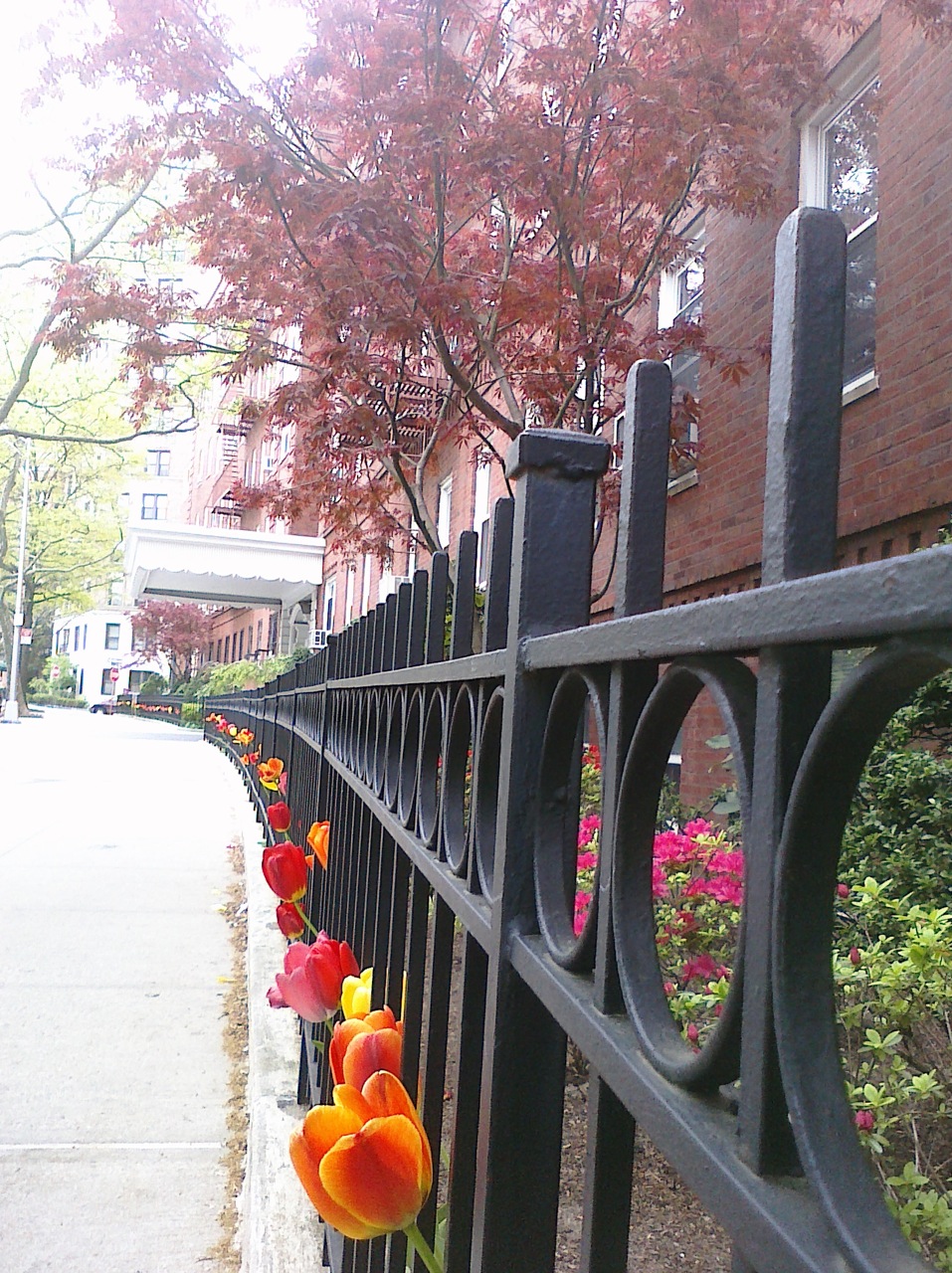
The magnolia tree does not consider its fallen petals, and the tulip does not anticipate its moment of perfect bloom. We humans seem to live so much in just those moments -- stuck in our sorrows and waiting and reaching for that something that may or may not bring all we want. I saw the litter of magnolia petals carpeting the sidewalk and was struck with their beauty, knowing full well that they were on the road to decomposition and disappearance. It felt similar to the last stages of my mother's life, when she was on hospice and functioning at the most concentrated and essential level of her character. How beautiful she seemed to me, no longer controlling or grasping, no longer measuring or despairing! There was a complete quality in her pleasure in holding a cup of tea, in her sensation of the texture of her own throat with her wandering fingers.

I planted onions a year after her death, scattering the fertilizer four inches below where the roots would grow, as I pushed the tips of the slightly thickened grass-like seedlings just under the surface of the warm earth. A cold wind was blowing, and the sun sparkled literally on the new green in the field grass. In that moment I could be complete, doing this action in this moment, knowing that some of these little onions will thrive and others may not, that there are responsibilities of watering and weeding, harvesting, and curing, eating, and savoring -- yet with no thinking about that. Each of those aspects will follow in their time if I nurture the seed of the moment. In my planting I chose to experience growth and possibility rather than loss and sorrow.

So oddly enough in grieving my mother's death, I found myself watering the seeds of being. This was one of her dearest gifts to me, showing me that the blooms do not grieve their petals as they fall to the earth.

Saturday, March 24, 2012

Aligning beyond the body


I am constantly shifting myself when I notice that I am in my habitual chin tilting posture, or hip cocked stance or sitting unevenly always left leg crossed. It reminds me a bit of trying to balance on one foot beyond just a few seconds. There is a constant negotiating in order to find that alignment; and with these habitual patterns in my body, I am noticing and adjusting in much the same way. Just as with seeking my balance, in these other habits it is my practice of cultivating awareness that brings me the possibility of aligning in spite of my life long patterns. I cannot change the asymmetrical nature of the body I live in, but I can definitely line things up in a way that liberates my movement, and makes much less trouble for my spine, joints, and muscles. Yes, I can lower the level of my own suffering.

This has a huge effect on my life, as the level of awareness that I now bring, not just to my "posture" you might call it, can and does apply to my feelings, my reactions, my way of operating in the world. That I can now even notice that my chin is tilting habitually, or that sadness is arising in a triggered response, is the result of cultivating mindfulness and allowing awareness to guide my actions and behaviors. I will be the first to admit that I have not been disciplined in my meditation practice for years and years, not at all. I have slowly and gradually been evolving into a more mindful person through my asana practice, and with what might be seen as a mild case of meditation until recent years when a nearly daily practice became more integrated.

The body is the vehicle for most beginning yoga practitioners. In fact most people think of yoga solely as the physical practice. Lots of yoga classes start and finish without the subtle secret remembering of the breath or the softening of the soles of the feet to sense the complex and delicate balance of energy and ease. And then the practice begins to take on that shape, when it is no longer about what it looks like on the outside even if there is a lot of attention paid verbally and physically to alignment and the principles of how muscles and bones work together. It is in the specificity of your own body, the very precise capabilities and inadequacies in that physical self and the way your own mind reacts and relates to all of this -- the instructions, the feelings, the physical risk taking and resting -- that the core of the work is revealed that the muscles you are truly developing are those of mindfulness and awareness.

Sitting in meditation, or walking or laying in meditation for that matter, can open your inner eye, so to speak, to the vastness of your energy beyond all the constant flow of thinking that keeps us occupied most of the time. The asana practice and developing the alignment of the poses is another way, that can augment or even introduce this process of cultivation. Noticing that there is a waste of energy in your arms in your warrior pose can lead to understanding that you waste energy in trying to control how other people do things. Noticing that you have once again fallen into the habit of turning the toes of your left foot in and are stressing your knee more than necessary can lead to noticing that you are putting too much on your calendar for one morning and are creating your own condition of frantic urgency.

Revelation and understanding are not predictable events, but through cultivating your awareness in asana alignment, you can illuminate and align the way you stand at the sink doing dishes. In this way you can cultivate being more aware of how you stand in the larger context of the life you live as well.

Tuesday, March 20, 2012

Rumi "Two Wings"


Observe the qualities of expansion and contraction
in the fingers of your hand:
surely after the closing of the fist comes the opening.
If the fingers were always closed or always open,
the owner would be crippled.
Your movement is governed by these two qualities:
they are as necessary to you
as two wings are to a bird.

from the Mathnawi III, 3762-66
edited by Kabir & Camille Helminski

Tuesday, March 13, 2012

Consider the Pearl, A Meditation


Swaying between the pulling tides of hope and fear,
we balance.
Our weight on the earth,
sitting bones softening deep into the support beneath
the spine, spacious and rising into the endless sky.

Allowing the jaw to loosen, even
the muscles in the shins go slack.
We balance the weight of the head
over the beating heart.

Consider yourself a pearl lost in the grass.
You sitting here.
Your skin a container for your inhale,
your shape ever changing.

Consider the pearl lost in the grass.
Like the dew drop resting on a leaf,
its membrane like a skin,
its clarity and translucence, ever reflecting.

We balance between hope and fear,
between the earth
and the endless sky.
Between the pearl's luminous solidity
and iridescent illusion of the dew.

Wednesday, February 29, 2012

starting here, being here


It really is all about cultivating the ability to be aware, and I don't mean hyper vigilant or super sensitive, just aware. The first growth of moss after a cold winter is so vivid, so green, so alive in its context of dry decay. Yet it is also the fallen leaf that draws my eye, the sense of total equanimity in its fall and landing, no judgment, no grief over its new curling, decaying form. That, juxtaposed with the intensity of the moss, stops me in my tracks. And it is my tracks that keep me going like a treadmill made of desires, away away away from the present moment and lost to my self. Even with the errand of walking the bucket of kitchen scraps to the compost bin I was like a mist without present form, drifting until that moss and resting leaves caught my eye.

So how to start here, no matter where "here" might be? I know that I cannot rely on external impulses that really just spark my reactive nature. It has become clearer and clearer that I must seek from within to find that sense of being that can focus my attention. Each breath is ripe with possibility when it comes to inviting focus, and cultivating the ability to be aware and stay present here and now.

Exhale without changing anything about the way you exhale. Allow the breath to slip back in without making any changes in the efforts or the action. Where are you now? Okay so there's a bit of self-absorption in this attentiveness, but keep your eyes open, with a soft focus. Keep your ears open allowing sound to find you from near and far. Keep your attention on the incredible but effortless inhale arising from each exhale.

Just stay here if you can as you walk slowly, mindfully. Notice the expansion of your inner spaces on the inhale and the lengthening and spaciousness of your exhale. When your mind has wandered off to watch a movie in your head, or begins blurring the present in order to see the future, just bring your attention back to the exhale and observe the arising inhale. Creating the seeds of mindfulness, you may find this present moment is fuller than you could ever have imagined with your mind.