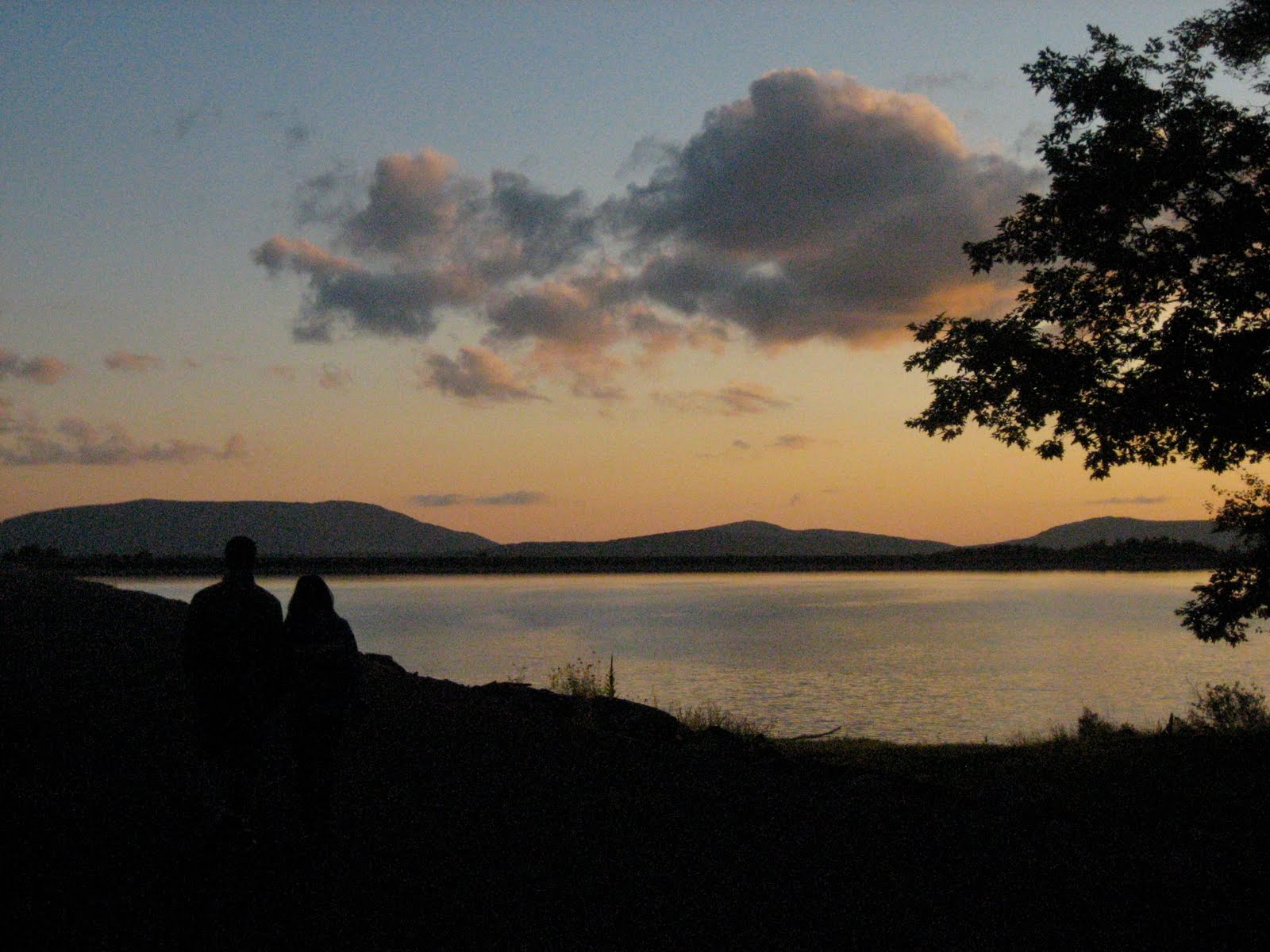
Impermanence is obvious. It's dark and then it's light. I'm sleeping and then I'm awake. This pear is not ripe and then it is. I'm breathing in and then breathing out. My eyes are watering in the wind. The water is boiling and transforming into steam. Oh, you can fill in a thousand immediacies that were different a minute ago, or two weeks ago or will be shifted by the time you read the next word. Blink. Blink.
In all of this intermittent reality what is truth?
Is truth drowned and lost in the sea of impermanence? Is truth substantiated only by the moment, an ever shifting, yet layered history, like the earth? A reality, when examined, that reveals conditions from yesterday, last year and millions of years ago? Doesn't what you find depend upon where you dig; and depends upon how wide a site or context you examine with what skills?
So it seems the truth is situational, and personal, yet constant and universal. Surely this is paradoxical. I apply my pre-existing assumptions, my learned expertise, my experiential practices to what is happening in this moment. If I cultivate an ability to be aware beyond the reactive, by repeating this practice, applying my attention in many different contexts, I can begin to perceive these personal elements: my pre-existing assumptions, my learned expertise, my experiential practices. Patterns of reactivity or my very own personalized systems of layering observations and experiences begin to separate out from the original sources, or instigations. Over time I can see how even these internal structures of mine have changed.
In this mash up of interpretation and experience, how do we know when something is true or not true? I remember as a teenager, my history class was given several different first-hand accounts of one historical event and we were asked to attempt to detail what actually happened from putting these differing points of view together. Of course, this was interesting and challenging, but even with the same multiplicity of accounts, each of us put together a different view of those events, as filtered through our own pre-existing interpretive structures.
Is it any wonder that in our current political context, reality is being played like a game of telephone where each person whispers to the next what they thought they heard, interpreted through their own pre-existing patterns of vocabulary, reactiveness, contexts etc.
Can yoga help us hear ourselves, each other, and the truth? I think so. Once we accept that we are each a complex mechanism of interpretation for each grain of truth, it's possible to see how, when seen from another vantage point of experience or understanding, the same object looks different. The object itself is not frozen in its form either, being a continuously transitioning little bit of impermanence itself! So there is lots of space in each moment for compassionate embrace of confusion, tolerant amusement at the desperate gripping for the one-true-reality that we all feel at one moment or another, and application of a series of observational mechanisms for helping us find our own foundation and stay open minded in that moment.
Paradox is welcome in my view through the practice of yoga. We can be physically releasing into the elemental force of gravity through our feet, while at the same time feel an uprising energy throughout the body. With practice, it possible to embrace both/and as a way of seeking truth too.
Showing posts with label Impermanence. Show all posts
Tuesday, October 1, 2019
Monday, April 21, 2014
The Beauty in Hidden Structures
We are so busy moving ourselves around in the world, that, like buildings, we see mostly the facade in passing. One of the gifts of living in a transitional bustling neighborhood of a major city is that there is constant building and tearing down so that, along with facades, all the inner structures are revealed coming and going.
Walking to teach my morning vinyasa class, I was stopped in my tracks by this gorgeous metal support structure. Light pouring through parts of it, it's undulations, shapes, reflective nature and span was strikingly beautiful. Just half a block further on, there is another one of these -- so it isn't any one-of-a-kind marvel at all -- that is covered in all the next stages of building with no light in it, and few of its textures revealed. In a week's time, they will both be invisible above ceilings and below floors.
Class was all about this in a subtle way starting with slow rocking in the hip sockets to feel how the thigh bones seat and mindful rolling through the sitting bone supports, to reveal spinal support even as the weight shifts. Eventually we moved into standing sequences, unfolding and refolding with the breath, and allowing the hidden structures to do their work deep in the interior of each asana (posture). Yet their presence could still be established, felt, and explored.
Walking to my next class I caught a glimpse of a building being demolished. It has stood for decades, though this demolition has been elongated over the last few years it is active once again. At the moment, the remaining structure is like a gem hiding in its case. I think of the breath, its textures, its stalwart nature, its foundational strength, its subtle delicacies. How grateful I am to live in this moment in a human form that I can explore at so many levels, cultivating awareness of the details and technicalities and the grand scale of the overall plan!
Walking to teach my morning vinyasa class, I was stopped in my tracks by this gorgeous metal support structure. Light pouring through parts of it, it's undulations, shapes, reflective nature and span was strikingly beautiful. Just half a block further on, there is another one of these -- so it isn't any one-of-a-kind marvel at all -- that is covered in all the next stages of building with no light in it, and few of its textures revealed. In a week's time, they will both be invisible above ceilings and below floors.
Class was all about this in a subtle way starting with slow rocking in the hip sockets to feel how the thigh bones seat and mindful rolling through the sitting bone supports, to reveal spinal support even as the weight shifts. Eventually we moved into standing sequences, unfolding and refolding with the breath, and allowing the hidden structures to do their work deep in the interior of each asana (posture). Yet their presence could still be established, felt, and explored.
Sunday, July 21, 2013
Being: Day Lilies for One Day
All day long, from the very start, I consider the lilies and am filled with amazement and wonder. It's not just that they are incredibly beautiful, so many colors, interacting with the light as it changes all day long. No, it's not that really. It is this inevitable truth that they open these insanely perfect blooms for just this day and then, that's it. If it's a rainy day, well, that's their day. If it's burning hot or windy or full of bugs or deer eating lilies for lunch or whatever, that's their day. And they bloom their very best, regardless.
I've tried to capture them with my digital camera but the colors are not right. These lilies are alive and blooming, I mean specifically, these lilies are totally saturated in the very act of blooming all day long. How can any frozen second capture that? Like this breath, or this eye blinking? A living moment.
And in the twilight of their one day, they are luminous. Some of them are already closing their petals having had their full day of possibilities. Some of them are just beginning to peel open that first petal at dusk in preparation for full bloom at sunrise. Some bloom into the night. When dead-heading lilies early in the morning (breaking off the spent blooms to make more space for the opening ones), one must be very attentive to those that close in the morning. They can look so much as though they are just opening.
I can only imagine this feeling of being completely in fullness in every moment. That this is the day for me. Yet it is true that this IS the day for me, and for you, and this day and this day. It seems so wildly unbelievable that we can have a chance to really live in every moment, day after day, when these remarkable and unique lilies only get one. Just one day. Live the one you're in.
| bud opening, bloom closing |
Sunday, April 28, 2013
Joy rising from the dirt
There is a point in March when looking around the garden and yard feels overwhelming to me. Cleaning up from the winter, re-establishing garden in the midst of the wild fields, raking the driveway gravel out of the grass, starting all over with the process of nurturing plants and watching them become food for other wildlife, tackling the ever shifting vagaries of vegetables that thrive and succumb to the myriad issues of weather, soil, attention and bacteria... Well, it feels like more than I can stand. Alone I cannot prune all the trees, dig out those rocks, re-form the raised beds or even haul all the brush. So there are relationship matters to accommodate in my spousal partnership, allowing the priorities of both parties and energy levels of each of us to be thoughtfully and non-judgmentally considered.
And then there is that moment in early April when we can watch the dry brown grasses greening up over the course of three days of sun and slightly warmer nights. All this and the compost pile is still frozen.
Still, in January I begin to contemplate the vegetable plots and their rotations and by February and early March the seeds arrive. They sit and wait patiently in their envelopes, just as I go through this churning of helplessness and interpersonal negotiations. Then, as trees bloom in warmer climates and all the yards in New York City begin popping with color and fragrance, the little corner of upstate New York begins to awaken too. Where my garden lies is in the shadow of a north facing hill, and once all the snow and ice is gone, the cold soggy earth starts sorting itself out. The birds return and start house hunting. Just putting out the bird houses is an act of faith in the dark days of March.
Though I have not yet been able to turn the soil, I must pile all the earth to the middle of the beds because the wooden forms around my raised plots have rotted after so many years. By the next week, there is new wooden framing, the plots have been turned, and yesterday the onions were planted alongside the now 8" tall garlic greens. My pants are filthy, hanging over the laundry basket waiting for me to put them back on for this morning's plunder of the thawed section of the compost pile. My garden maps have been redrawn to make room for the arugula, spinach, lettuce mixtures, radishes, snow peas, sugar snaps, little shell peas, carrots, chard and beets. Packets of seeds sit in my basket, still waiting for my clumsy gloved fingers to open them in the bright sun and cold wind.
For the last two nights I have woken as the waxing full moon set across from the rising sun glowing behind the hill. My tired muscles slightly regrouped after the night's rest, I am filled with joy at the prospect of another few hours laboring to welcome the seeds into the dirt we have prepared for them.
This is the practice. Seeing what is so and accepting that all of it is connected. Developing the ability to abide: patiently acknowledging while not judging the tough times, diligently putting in the effort as one must, but softening as one can; welcoming the joy that arises from the dirt with full knowledge that not all the seeds will thrive and some will produce splendor to share even with unwelcome guests. We are not separate from this ever-shifting inner and external see saw. It is the practice that gives me balance and equanimity. Now to put on those mud-shoes and get the morning job done.
And then there is that moment in early April when we can watch the dry brown grasses greening up over the course of three days of sun and slightly warmer nights. All this and the compost pile is still frozen.
Still, in January I begin to contemplate the vegetable plots and their rotations and by February and early March the seeds arrive. They sit and wait patiently in their envelopes, just as I go through this churning of helplessness and interpersonal negotiations. Then, as trees bloom in warmer climates and all the yards in New York City begin popping with color and fragrance, the little corner of upstate New York begins to awaken too. Where my garden lies is in the shadow of a north facing hill, and once all the snow and ice is gone, the cold soggy earth starts sorting itself out. The birds return and start house hunting. Just putting out the bird houses is an act of faith in the dark days of March.
Though I have not yet been able to turn the soil, I must pile all the earth to the middle of the beds because the wooden forms around my raised plots have rotted after so many years. By the next week, there is new wooden framing, the plots have been turned, and yesterday the onions were planted alongside the now 8" tall garlic greens. My pants are filthy, hanging over the laundry basket waiting for me to put them back on for this morning's plunder of the thawed section of the compost pile. My garden maps have been redrawn to make room for the arugula, spinach, lettuce mixtures, radishes, snow peas, sugar snaps, little shell peas, carrots, chard and beets. Packets of seeds sit in my basket, still waiting for my clumsy gloved fingers to open them in the bright sun and cold wind.
For the last two nights I have woken as the waxing full moon set across from the rising sun glowing behind the hill. My tired muscles slightly regrouped after the night's rest, I am filled with joy at the prospect of another few hours laboring to welcome the seeds into the dirt we have prepared for them.
This is the practice. Seeing what is so and accepting that all of it is connected. Developing the ability to abide: patiently acknowledging while not judging the tough times, diligently putting in the effort as one must, but softening as one can; welcoming the joy that arises from the dirt with full knowledge that not all the seeds will thrive and some will produce splendor to share even with unwelcome guests. We are not separate from this ever-shifting inner and external see saw. It is the practice that gives me balance and equanimity. Now to put on those mud-shoes and get the morning job done.
Labels:
acceptance,
balance,
cessation of suffering,
choices,
cultivating awareness,
discipline,
efforting,
emotions,
equanimity,
gardening,
Impermanence,
natural world,
non judgment,
yoga practice
Tuesday, April 23, 2013
Transition is a State of Mind
So much emphasis is placed on college applications that the whole last half of high school is colored by this. Once accepted, there is another phase of accommodating all the changes taking place in moving to a new way of operating, often in an entirely different location. Once there's a rhythm established, many people start taking semesters abroad or as interns, getting part time jobs and turn their face towards what happens after graduation. Even semesters starting and ending, summer sessions and work study jobs coming and going, all of this seems like an enormous sequence of change upon change upon change.
It is much the same as a child learns to move in the world from sitting, crawling, standing, that hand-over-hand cruising, to walking, running, climbing (not always in that order!). To children, adults seem complete and finished as though all the pieces are set and the patterns established. To some degree this is a way of operating that many people try to adopt, sticking to their patterns, hanging on tight to who they think they are, or want to be.
But life is entirely transitional. Right down to the cells in the body, we are an ever shifting, changing organization of bits and systems. We live only in this moment, and whether we call it transitional or not, this is that moment.
When we tell ourselves we are in transition, or classify someone else as in a "transitional stage," we are emphasizing our idea that they are developing something and will not remain the way they are now. This reflects our opinion or impression that perhaps that what is happening now is not sustainable, or that it is only a temporary way of operating or feeling. Certainly we comfort ourselves by saying that the deepest moments of intense grief are temporary, and we warn each other to enjoy the early days of childrearing as they "go so fast." What happens in the mind when we accept that every moment is such a moment, that we are constantly developing and can not remain the way we are now?
I stopped my class in mid stream in their sun salutations (Surya Namaskar), a series of yoga asana that are strung together in a fairly routinized way, though in my class you can never figure what I'm going to suggest. Each student realized that they had not placed their body as carefully as they would have if they had known they would have to stay there ... they had defined this sequence of postures as a flow of transitional movements, and discovered that this had occurred without much intelligence, relying predominantly on pattern and habit. Yoga is a practice fundamentally of unifying, "yoking," awareness with the actions of being.
Waking up awareness is one of the darts that I throw at the balloon of habit in the mind. Cultivating conscious attention to include even the most mundane, momentary bits of life is where the vibrancy and depth of being resides. The yoga asana practice is a mechanism that can awaken an alert body and mind, and help develop and train this level of consciousness and awareness without efforting. It takes focused attention to see that "transition" includes every moment, and that in every moment we can be completely present in the experience. We may never visit this place again, or be 19 years old, or feel confused about this particular thing, or be as broken hearted, or as proud and happy, or whatever it is. Those living with cancer know this feeling of uncertainty as a constant, rejecting or accepting the moment in all its fullness, again and again. Being fully present in this moment is a state of mind, and thinking that this moment is just on its way to some other moment is also a state of mind, that leaches some of the potential from "now" and projects it onto "then."
Convenient to explain uncertainty and the unknown as a transition if we are not sure of what is happening and want to grasp at the next moment (or the remembered moment) as more settled or resolved or successful, etc. This, too, is the mind setting a scene for the story we tell ourselves. It is still only in this moment that we are here, living. Impermanence is the way of all living beings. Just look around you.
Labels:
alertness,
attention,
Being Awake,
being present,
choices,
consciousness,
cultivating awareness,
Eight-fold path,
Impermanence,
non attachment,
not grasping,
present moment,
yoga practice
Saturday, April 20, 2013
Body as Home, Breath as Being
Sometimes when you've been out on your feet for many hours, getting into the car feels like home. I've seen people pick their noses in their cars as though there were curtains through which no one could see. The car is a vehicle, a vehicle that moves through space giving a sense of enclosure and perhaps even a sense of security. Out in the world it is our own body that provides us with that home (complete with a fabricated sense of security) but on the body we actually do place curtains in a way: our clothing, styles, habits, the stuff of appearances. We dress ourselves as we hope to be seen, within the limitations of our ideas about our self and our willingness to put time and resources into the project. This physical vehicle in which we experience life does not really have an external life of its own. We can surely be judged by others based upon it, but if you judge me by my shoes, I become invisible as a living being. It is our breath that animates us. Awareness of our self as a living being can shift us away from this false sense of privacy or security into the truth of being fully alive in the world. The breath can help us feel and fill that space where we are authentic, alive and at home. No curtains needed.
So often it is the metaphorical curtains that seem to fascinate us, about ourselves and on others. We use the outer shapes and decoration to tell one story after another. Our mala beads, turban, yarmulkas, or veil all speak of the culture of our spiritual practices, reveal a bit about our desires and self concept. Our fashions show our grasping at affinity groups, and hint at our philosophy to avert the worst of our fears. We imagine physical condition as a reflection of character. All of this, like a silk wrap, falls away when we cultivate our focus on the breath itself. There is no strategy about being who we are when we are simply being a living being. There is no style or design to it, other than the human form that uses this continuous influx and outflow. Stories we have been told, and the ones we tell ourselves or another, can also be seen as shifting reflections in the windows.
The human form has a shape and that shape has its effects. Like any point of origin, it's influence is both subtle and deep. If we find ourselves living in a female or male body, or with chronic illness, or with acute sensitivities, it can shape us invisibly and visibly. Seems to me, though, that even these attributes are window dressing rather than the core of the living self. We can continue to see each other as these external forms, and ourselves as well, or we can begin to cherish these forms as expressions, and see beyond the curtains.
The mind is like a vast loom, constantly weaving all available strands into patterns. Each strand, if pulled, unravels only one part of this constantly shifting design. It is being, the presence of mind without attaching to the distractions of the curtains or the shifting designs, that unifies all of our life experiences into this life we live. It unifies this life into a much larger fabric comprised of all the lives around us, known or unknown to us, and in fact to those who came before us and will follow us. We do not make that happen by fingering our prayer beads, or covering our faces, but by breathing in and breathing out. It is part of the yogic path to draw awareness within, to cultivate a single-pointed focus, and to observe the workings of the mind itself. The breath is the constant, regardless of the strands, the patterns, or the curtains we use to cover to the changing reflections.
When a thread is pulled and parts begin unraveling, we are willing to take that which remains as though it were whole. This distortion is what we think we know. Operating from this is like imagining that the window is in fact the self, with or without curtains. It is easy then to ignore the space within the vehicle, shaped by the breath, that offers authentic wholeness, regardless of curtains open, closed, threadbare or missing. Standing on the subway underneath NYC, it is not my shoes, or my hair or skin color, or my language that define my life. I am using all of that to decorate, and perhaps convey that I am a person in a community with a task and appetites. it is my breath that defines me as a living being, something I share inarguably and intimately with every other living being on the train. It is the awareness and acceptance of this energy exchange that keeps my heart open, my mind alert, and gives me a place in which to be truly home anywhere.
Tuesday, April 16, 2013
Life is not a Rehearsal: Each Moment is the Performance
Practicing, whether a musical instrument, painting, asana or other activity of mind and body, is a process of building stamina, skill, pattern, awareness, and technique. Yoga is not different in many ways from any of these other pursuits. A spiritual practice or a modality of scientific inquiry both benefit from repeating the walk along the pathways of the mind, in some ways codifying these movements into a chosen range of adaptations. We shape the way we think, our thoughts shape the way we react, act, feel. It is in this inquiry that we discover our selves and the world again and again.
Even in the practicing, though there are imperfections and sometimes struggles, it is not a rehearsal in order to get it right. The practicing is in itself the performance, but with a different audience or outcome. It is the self that performs, and the self who is transformed by the performance.
There is no moment when you are not your self. Even in moments when you might say, "I am not myself today," you are present only in that moment as the self you actually are, feeling off kilter. Our idea can shift about who we think we are, and we construct the ways in which we imagine we are seen by others. As with playing music, it sounds beautiful to one person, boring to another, intriguing to someone and intolerable to someone else. It exists only in the moment that you create it, and though you might record it, it lives then as a recording, played in a moment, reacted to in that moment. It is no longer your life, but a product of your life.
So with this in mind, it doesn't take much to see that what you say, the face you make, the food you put in your mouth, the way you touch another, the place you rest your eyes, all make up the life you actually live. There is no moment out-of-mind, even in the flow of ecstatic creativity that might bring out the music or the art, the breath or the dance, this is your moment. It is in this context that I contemplate the principles of right action and right speech.
Once I was in my dad's painting studio looking at some new work and he said, "Oil painting is like a rehearsal where you can keep going back and redo, or undo, or rethink, and remake; where watercolor is a performance with every stroke of the brush, this is it."
Being present in each moment is like living a watercolor, where each movement of the breath is the performance of life. Is there pressure in this? I don't feel it that way. I see this spreads out any pressure into a general sense of upholding personal responsibility in all things, including sharing responsibilities with everyone else for the world we are making together, and accepting responsibility for the range of feelings that arise. This is not about perfection, or blocking out the "bad," but rather giving up the idea of "good" and "bad" and being here, in it right now as it is.
Wednesday, April 3, 2013
If you crave certainty let death be that, for now.
If you crave certainty let death be that for now, for once you achieve that you will see that it is not the goal you imagined but just another moment passing.
Finding the middle path is not a grip on everything. It is like walking with open palms while you feel the gentle swinging of your hips. Pile up desires like clean laundry, used and cleaned for reuse. Then hang them on the line in the sun. Feel the wood of the clothespin. The tree roots, the hand on the machine spitting out little springs, the pleasure of the grip of pin to line that will hold desire as it flaps in the wind, changing colors.
How does it feel to see them there? Beautiful as they hang and flap. Separate from you. All lined up for you to continue in the endless cycle of craving.
Where are your feet, your hands, your hips now? Undressed from the layers of desire. Weightlessness of the middle path poses a paradox. How can you clutch at your foundation and reach outwardly when there is only this shimmering self, naked and aglow?
I like to use the words "find" and "allow" when I teach yoga. I invite students to come with curiosity and acceptance. I know how hard this is and that we would rather wrap ourselves in the beautiful desires that mark us and make us resemble our expectations. Freedom doesn't wear such specificity nor can it. As I see my outer self flapping in the sun, making its own shadows, I can feel the sweetness of being without all that.
Death can be seen as the ultimate degradation or the sublime elevation, the cause of suffering or the release from suffering. Perhaps it is a mirage we can use to teach us about the nature of impermanence and the clutching for certainty that so often run our emotional and psychological programs. Steve Jobs spoke eloquently about his own mortality as the predominant inspiration to make the most of his life.
What good does it do to accept impermanence? Well as long as we resist this idea that the moment is the truth of our life, we clutch at something else. We look back, we worry about what is to come, we contort ourselves and others with judgments based on what we think of this or that.
Accepting impermanence softens the fear of loss, the fear of illness and eventual death. This is fundamentally where suffering comes from, according to yogic and Buddhist philosophies. If I need to be certain of something, let it be death for now. This will give me enough desire and craving to pin on the line and I will not care much whether the pins come loose in the wind.
Finding the middle path is not a grip on everything. It is like walking with open palms while you feel the gentle swinging of your hips. Pile up desires like clean laundry, used and cleaned for reuse. Then hang them on the line in the sun. Feel the wood of the clothespin. The tree roots, the hand on the machine spitting out little springs, the pleasure of the grip of pin to line that will hold desire as it flaps in the wind, changing colors.
How does it feel to see them there? Beautiful as they hang and flap. Separate from you. All lined up for you to continue in the endless cycle of craving.
Where are your feet, your hands, your hips now? Undressed from the layers of desire. Weightlessness of the middle path poses a paradox. How can you clutch at your foundation and reach outwardly when there is only this shimmering self, naked and aglow?
I like to use the words "find" and "allow" when I teach yoga. I invite students to come with curiosity and acceptance. I know how hard this is and that we would rather wrap ourselves in the beautiful desires that mark us and make us resemble our expectations. Freedom doesn't wear such specificity nor can it. As I see my outer self flapping in the sun, making its own shadows, I can feel the sweetness of being without all that.
Death can be seen as the ultimate degradation or the sublime elevation, the cause of suffering or the release from suffering. Perhaps it is a mirage we can use to teach us about the nature of impermanence and the clutching for certainty that so often run our emotional and psychological programs. Steve Jobs spoke eloquently about his own mortality as the predominant inspiration to make the most of his life.
What good does it do to accept impermanence? Well as long as we resist this idea that the moment is the truth of our life, we clutch at something else. We look back, we worry about what is to come, we contort ourselves and others with judgments based on what we think of this or that.
Accepting impermanence softens the fear of loss, the fear of illness and eventual death. This is fundamentally where suffering comes from, according to yogic and Buddhist philosophies. If I need to be certain of something, let it be death for now. This will give me enough desire and craving to pin on the line and I will not care much whether the pins come loose in the wind.
Tuesday, February 12, 2013
Meditation: Hold the Railing in the Bottomless Pool
Right in the middle of dinner, a mood settles in, changing the textures of experience, tamping down on interactions and forming strange silences. There's a deep pool of possible feelings upon which to draw, yet like sipping through a straw, only one small part is sucked up, feeding the whole. It wasn't like this just moments before, or perhaps yesterday was different. It feels as though a shift, like a tectonic plate, happened, and without knowing how it happened, or making up reasons why it happened, we feel as though standing in a place from which life looks different. Right in the middle of life, someone we love leaves us and we are lost in the bottomless pool.
It doesn't seem like a choice, since it is something we feel. Feelings surround us, like an immersion, and we cannot feel the bottom of the pool with our toes any more. Seems like either we drift with it, paddle in it, or drown in it. Is feeling really a matter of mind? a reaction to a condition? Does it help to know that the condition is impermanent, or is this feeling of the impermanence of everything like being in a bottomless pool, hopeless of finding our feet? Forever without the comfort of grounding? This is the wash of grief, the depth of loss, the fear of looking forward or letting go of what is past, unable to see the continuum of events as a constantly shifting mirage without feeling despair and agonizing incompleteness.
How do we live with equanimity if there is no bottom to the pool? Think of the shallow end of a swimming pool. There are stairs to give a gradual way into the water, where one can stay until more at ease with the depth and the shift from dry to wet. Even in the deepest end of the pool there are ladders for one to climb out, or to hold onto for a moment of rest. Understanding that the pool is bottomless does not mean giving up these supports, in fact it helps to see them as exactly that. There is little hope of understanding the sea simply from standing on the shore, we begin by wading in. We cannot know the deepest parts on our own, nor traverse the breadth of the sea as a fish might. Yet we can hold the concept of the mountain ridges beneath the surface, the universe of life and energy cycles playing out throughout. These are like the steps into the pool that we can use in approaching the ocean of our feelings and reactions, the seemingly boundary-less and overwhelming reactions we can have in a moment of loss, disappointment or fear.
Setting aside time from the viewing platform of meditation or a yoga practice can allow us to visualize the stairs, and the vastness of the bottomless pool, without reactivity. We can watch the whole scene play out without immersing ourselves in it. Notice the fear or grief arising, the avoidance or the urge to plunge beyond our depth. This moment of observation can be seen and even felt without being lost in it. We can learn to train our attention to hold the railing of the ladder while we let the mind follow the waves outward into the deep end. Let the breath itself be your railing.
Labels:
being present,
clarity,
cultivating awareness,
despair,
Drishti,
emotions,
equanimity,
expectations,
foundation,
grief,
Impermanence,
loss,
meditation,
non-attachment,
single pointed focus
Saturday, February 9, 2013
No Contradiction: Routines, Patterns & Alertness
I remember the arguments with my kids about getting their homework done. It seemed so simple to me that if they would just routinize it, it would get done, leaving them free to do the other things they wanted to do. The more they resisted it, the longer it sat before them, denying them the possibility to move on. Isn't it the same with all distraction, procrastination and anxiety? It blocks the way between what we think we have to get done, and what we'd rather be doing. In that case, I do think that creating a routine can help. It is partly for this reason that many people support the idea of setting aside a specific time of day for a meditation practice, or signing up for a yoga class (or practicing at home) at the same time of day every week or every day. Knowing that it is on the schedule, that a place has been made for it, can stream line the decision making. Make the decision once, and then just follow through again and again.
At the same time, one of the revelations of meditation and yogic practice is the awareness of patterns that we have formed and that guide our behaviors mostly without our knowing of them. Cultivating awareness allows us to run into them quite directly and by seeing them, we gain insight into ourselves, into the traps we set and the strengths we have. Perhaps it is as simple as noticing that in a seated posture, we nearly always cross our right leg over the left. Simply seeing this can help us understand why our right inner hamstrings are so tight, or why we tend to pull our low back muscles on the left. Seeing this can help us remember to mindfully cross left over right, gradually undoing the habitual training of muscles and joints into a more symmetrical and supported condition.
All patterns do not require "undoing." Knowing that our digestive system works better on smaller amounts more frequently, or by starting the day with plain water before that cup of coffee or tea, can be very useful and can protect us from unnecessarily struggles. Knowing that we tend to blame external causes when we are late for something, or get anxious about things the night before, are patterns that can be addressed and in many cases assuaged just by acknowledging them as temporal behavior and not permanent. We may see that this doesn't help us deal with anything, and that other kinds of behavioral steps can be put in place to ease the way and change the pattern. A step can be as simple as setting a timer to get you off the computer in time to get your coat on and catch the train, rather than missing that train and arriving late. Routinize a few minutes of meditation (even 5- 10 minutes) in the evening before going to bed can begin to dissipate that night-before anxiety, allowing you to sleep better and see the next morning with more equanimity.
Everything is happening in this very moment. Nothing tomorrow is happening now, nor is anything from yesterday happening now. Sounds ridiculous, but our minds and our feelings can be quite attached to this way of thinking -- about what we thought happened or will/might happen. We can be consumed by our reactions to something that is not happening now, and literally wipe out all the possibilities in this moment. I'm not just talking about the mind drifting in the middle of a conversation when you stop hearing your companion and are startled back into the moment by their silent pause, waiting for your response to something you actually didn't hear. I'm talking about right now -- not noticing the slump in your shoulders or the effort of your eyes as you read this. The actual condition of balance in your body, the sweetness of the light around you, appreciation of the speed with which your mind absorbs all this information and catalogs it, making meaning or discarding it.
Alertness can help you gain the power of mindfulness. You can cultivate awareness in this moment, and put routines in place that support you, for example using abdominal muscles to help stabilize your pelvis and support your low back when you sit at the computer, or committing to that 10-class card so you can just sign in and go to yoga every Monday morning to start your week. Awareness allows you to acknowledge the patterns that bind you to behaviors that cause distress, like turning out your right foot when you walk which slowly stresses your hip and knee over time, or speaking over someone who is speaking to you because you are anxious to be heard. Once you learn to be alert, you have options. Being present in this moment, you can use this moment, and establish routines and patterns that support you, rather than trap you.
Sunday, February 3, 2013
Making the offering, Being the offering
I've been enjoying poems from Gregory Orr's 2009 collection, "How Beautiful the Beloved." There is simplicity and deep resonance of losing oneself in the grace of love at the same time yearning to hold what will inevitably be lost. Everything is impermanent.
"All those years
I had only to say
Yes.
But I couldn't.
Finally, I said Maybe,
But even then
I was filled with dread.
I wanted to step carefully.
I didn't want to leap.
What if the beloved
Didn't catch me?
What if the world
Disappeared beneath my feet?"
As a teenager I was put in the position of making the family meals, and I've held that role fairly continuously throughout my adult life. I don't remember thinking of food as a token of love, and in those early years it was a heavy load on top of my schoolwork, my awakening political awareness and the swirl of emotional troubles between my parents. As a wife and mother I came to feel the job of feeding as a deeply nurturing one.
"So many were given only
A dream of love,
So many given a glimpse,
And that from such a distance.
Who am I to be ungrateful
Who saw the beloved
Face-to-face?"
One month ago my husband and I essentially became vegan, eating no meat, no dairy, no processed grains, sweeteners with the addition of eschewing all cooked and most uncooked oil. (For more on this, see my related blog eat2thrive.blogspot.com.)
"Surrender everything. Give up
All that's precious --
That way you won't be tempted
To bicker with yourself
Over scraps you still control.
Besides, who knows the depth
Of her pity? Who knows
How far down
He can reach with his love?"
Food has become transformed into a vast array of beautiful blessings. Each fruit, vegetable, bag of grain, bowl of soup, pot with simmering leeks, plate with the stain of beets, crunch of jicama and scent of lime or garlic brings such gratitude and pleasure.
We spend way too much time imagining ourselves to be lacking something, avoiding something. This pretending to be incomplete and unworthy stands directly in the way of living our fullest life in this moment as we actually are.
Again from Greg Orr:
"How beautiful
The beloved.
Whether garbed
In mortal tatters,
Or in her dress
Of everlastingness --
Moon broken
On the water,
Or moon
Still whole
In the night sky."
Labels:
acceptance,
authentic self,
cessation of suffering,
expectations,
gratitude,
Impermanence,
love,
memory,
mortality,
nurturing,
patterns,
perception,
poem,
responsibility,
transformation,
universal heart
Wednesday, December 26, 2012
the mind of not all or nothing: just see what emerges.
Walking in the light powdery snow, I was bewitched by the transformations, leaves became cups and simultaneously appear as knife-like edges in the snow. Distances in the valley are aflutter with white flecks turning air and space into volumes. Definitions disappear. Here the submerged log emerged with its tinge of velvet green moss. What is the truth about the light snow, the maple branch below or the leaf litter? Can the surface be surface, while the depth is a huge mass of fallen tree, and the snow be falling too?
All bound up in thinking, I bind myself up with projections, goals, memories, ideas. Reaching for the shapes that I think, I practically block any sense of the real. I cannot pretend to give up thinking, nor do I want to do that. I am beginning to see that it doesn't take huge complicated tools though to loosen the tightness of the bind of my thinking. It is like the way I learn not to reach too hard to catch my own hand to bind an asana only to give up on my spinal alignment. It begins with noticing that my thinking is confining me.
More and more I see how selective my letting go has been. I seem to release this grip, but not that grip. I believe this, but not that. I tolerate this, but not that. Once I see this personal structure, this selective way of grasping at one aspect while avoiding another, I have the opportunity to be more fully. Truth and freedom, equanimity and clarity glimmer in all the levels of letting go. It is not an all or nothing proposition, like light appearing in the dark. It is always light.
In my snowy walk, the most striking thing happened as I turned to return to the house. I felt thrilled and surprised to the core to see the subtle impression of my own tracks: a slight disturbance in the powdery snow with delicate crushing of the leaf edges into the powder. This evidence of my own steps seems most marvelous of all -- holding for just a moment all the wonder of impermanence and presence.
Sunday, December 9, 2012
Empty Attic: No Object, No Fix, No Problem
I am living in the lap of luxury, teaching and practicing yoga and meditating. I have heat when it is cold, I have food when I am preparing to feed my family, and various means to provide for holidays and birthday celebrations. I can walk to my work, which has become an offering from my essential self using my energy in ways that gives what I have to give and brings back to me what I need. This is not a manipulated view of my life, but one that reflects the truth of my daily experience.
People I love have deep on-going struggles, friends of mine are suffering with terminal illnesses and the attendant treatments, entire nations in the Middle East are losing the ground upon which civil government stands, and many people have lost their homes and livelihoods in New York City, Haiti and the Philippines. This is not a manipulated view of my world, but one that reflects the truth of my daily experience.
How to position myself to accommodate these truths? The first step is to stop attaching to a particular definition of what is good or bad about what I perceive; the second is to approach each aspect of that with an open heart that accepts what I perceive without assigning blame; the third is to nurture that open heart from a state of gratitude so that all the possibilities appear rather than a one-solution frame of mind (this includes allowing the feelings to arise rather than clamp down on this one and pretend that one is the good one).
I will not cure the causes of cancer, not stop the pain of personal loss, nor create a plan for civil society or dispel confusion even in one young sweet mind. I do understand that each of us has a life span, and that we cannot know its length or purpose. We use energy every day, turning towards goals, tasks and practices to provide what we imagine as necessities, satisfactions, support, and sometimes generosity. To a large degree, we do this in whatever context we find ourselves with more or less angst or joy.
Here in the last weeks of 2012 I see my operating fundamentals are: not attaching to, grasping at or hoarding meanings, goals or objects; seeing situations as causes and reactions rather than as a duality of good or bad; remembering again and again that gratitude in this moment will lead me out of confusion into clarity.
In this way I can enjoy my mysterious little part here on earth. Living in a human body fraught with its own foibles, applying my thinking as I have learned and relearned and unlearned, and surrounded by the context into which I stumbled by my birth, growth, and connections to other people. So easily we slip into the space made for us as the children of these people, living in this place, growing up here, and having these good and bad experiences. Eventually I have come to see that all drifts away like mist, and while still honoring my ancestors and my own experiences in earlier contexts, I have much greater freedom in the moment than I ever imagined. All the stuff clutched in my mind, attic, closet. barn, or basement can make its way back into the world without adding or subtracting from me.
People I love have deep on-going struggles, friends of mine are suffering with terminal illnesses and the attendant treatments, entire nations in the Middle East are losing the ground upon which civil government stands, and many people have lost their homes and livelihoods in New York City, Haiti and the Philippines. This is not a manipulated view of my world, but one that reflects the truth of my daily experience.
How to position myself to accommodate these truths? The first step is to stop attaching to a particular definition of what is good or bad about what I perceive; the second is to approach each aspect of that with an open heart that accepts what I perceive without assigning blame; the third is to nurture that open heart from a state of gratitude so that all the possibilities appear rather than a one-solution frame of mind (this includes allowing the feelings to arise rather than clamp down on this one and pretend that one is the good one).
I will not cure the causes of cancer, not stop the pain of personal loss, nor create a plan for civil society or dispel confusion even in one young sweet mind. I do understand that each of us has a life span, and that we cannot know its length or purpose. We use energy every day, turning towards goals, tasks and practices to provide what we imagine as necessities, satisfactions, support, and sometimes generosity. To a large degree, we do this in whatever context we find ourselves with more or less angst or joy.
Here in the last weeks of 2012 I see my operating fundamentals are: not attaching to, grasping at or hoarding meanings, goals or objects; seeing situations as causes and reactions rather than as a duality of good or bad; remembering again and again that gratitude in this moment will lead me out of confusion into clarity.
In this way I can enjoy my mysterious little part here on earth. Living in a human body fraught with its own foibles, applying my thinking as I have learned and relearned and unlearned, and surrounded by the context into which I stumbled by my birth, growth, and connections to other people. So easily we slip into the space made for us as the children of these people, living in this place, growing up here, and having these good and bad experiences. Eventually I have come to see that all drifts away like mist, and while still honoring my ancestors and my own experiences in earlier contexts, I have much greater freedom in the moment than I ever imagined. All the stuff clutched in my mind, attic, closet. barn, or basement can make its way back into the world without adding or subtracting from me.
Labels:
acceptance,
authentic self,
Awareness,
clarity,
emptiness,
expectations,
false self,
gratitude,
Impermanence,
meditation,
nondualistic,
not grasping,
patterns,
present moment,
simplify,
transformation
Saturday, August 11, 2012
Certainty is an act of Imagination
Every moment is an opportunity for drama. Consumed with physical and emotional feedback, we play out scene after scene from the moment we wake and even throughout the roller coaster of dream life at night. As with traveling in a foreign land, each difference from our expectations can bring thrill or frustration; each aspect of experience or sensation that we cannot control or explain offers us another chance for self involvement and crippling attachments. We confirm our suspicions, we seek out the familiar among the unfamiliar, we attend to our reactions with endless interest.
Being fully present in the moment does require a level of engagement that is intense, but without the drama of self-centeredness that seems to block vital qualities of awareness. Noticing what I feel, physically or emotionally, is not the same as being ruled by that or literally living from that reactive state. I am beginning to see certainty as an act of imagination, a construction that we each build with the blocks of experience available to us. It is complex to function within the wash of conflicting feelings and insights that arise when I don't pin down meaning, or block out the untamed data as it comes in. Yet that is a most wonderful way of experiencing the self in action.
There is nothing wrong with knowledge, experienced or learned in other ways. But knowledge is not in a vacuum. To be useful to me, it takes seeing context and conditions and accepting the array of possibilities that can literally change what I think I know. Letting go of knowing as "certainty" and understanding that illusion does not mean unreal, just profoundly impermanent.
And as when traveling in a foreign land, as soon as I begin to make generalities, I know that I am blind to the truth, which is myriad and ever changing. I consider the variation when opening one bottle of wine after another, made from the same grapes grown in the same row of vines, harvested the same day and filtered and fermented the same length of time. This just reinforces my growing sense that an open and curious mind gives access to the broadest palate of experience, and an intensity in living.
What else are we here for, if not to experience our own lives, through the filters we have developed along the way? We can let the filters be like blinds and shutters, that we can adjust once we see them clearly. We cannot really set this aside, but can live with blinds and shutters set in position, or take on learning to see them for what they are and adjust them for the light at any time of day or night. We can still protect ourselves from groping in the dark or being blinded by the brilliance of direct sunlight depending on what we require for visibility or privacy. Imagination can help us make these adjustments and enjoy where we are in the moment.
Saturday, July 7, 2012
Weed Control or Right Action?
Every time I weed or water, I take stock of how things are going. I've made decisions to push back the wild field growth and plant specific flowers or edible fruits, roots or leaves. This gives me responsibilities but doesn't really put me in charge. When it doesn't rain for days on end, I feel the urge to provide water, since I'm the one who asked this plant to grow in this place soaked in sun and dried by wind. If it rains too much, I am the one who puts boards, or rings of salty or sharp materials out to attract the slugs from the plants that get besieged the most. I know that deer will prune my cherry tomatoes and lily buds, some woodchuck may eliminate my zinnias or half a cucumber plant, the birds and chipmunks will some of the blueberries. I understand that all my effort to weed in any one place will be repeated again and again and grow over if I neglect that task.
Today, after many sunny days, there is a drift of cloud cover and I know that means today's task will be transplanting. There are just a few plants that are not thriving as they could. In a couple cases, I attribute this to wrong placement: planted where once they had dappled shade and now have too much sun because of the loss of a nearby bush or tree or the opposite case, planted once in sun and now because of the growth of nearby trees, not enough sun to flourish.
For me it is intuition more than garden design that brings the shovel to hand. I know that where I plan to put that astilbe it will have a good mix of what it needs, but I also know that to make even a small hole for it, I will be excavating rocks and filling in with soil from somewhere else. I cannot control what will happen. Sometimes moles will eat the roots of a healthy happy plant and it withers and dies. Sometimes for two years in a row I don't see a plant bloom because the deer have chomped the buds and then there is a spectacular Spring show, unlike any I've ever seen because somehow the deer passed it by that season.
Yet I do feel the weight of my actions, playing with the lives of plants, even if for my own good purposes or their better cultivation. I carefully cut the chard leaves that we will eat, leaving the plant's newest growth to continue. I cut the lettuce, or broccoli rabe in the coolness of morning, water in the coolness of evening, and do that which I know to do in ways that I hope disturb the natural cycles the least. I see the wilting leaves in the hot sun, and think about the evening's watering to sustain them. I know that the buds that open in the morning care nothing for me or my appreciative gaze.
I have taken it on to grow these beautiful and edible plants where there were once different beautiful and edible plants (though perhaps not edible for me), leaving many wild patches of raspberries and blackberries, roses and barbary, gooseberries and elderberries, along with the field full of grasses and thistles, milkweed, joe pye weed, yarrow, vetch and so many others whose names I may never know or cannot remember. As soon as I turn my back, the plants I have planted here will struggle to keep their footing as the wild ones return. Each seeding for its own survival, spreading roots, and seeking out the moist earth.
Today, after I moved an echinacea from deep shade into a sunnier spot, the sun came out. That poor plant drooped, even with the good soil and water I had given it. I put a wire cage around it and draped a white tee shirt over it for protection. Half an hour later, the clouds came in seriously and sporadic rain drops began to fall. The tee shirt came off, the droopy stalks still sagged, but perhaps tomorrow will straighten them up. The coral bells, astilbe, heliobore, and goatsbeard have all settled down as though they were just waiting for this moment. Today the gray sky brings me joy.
Friday, August 12, 2011
Shadows in August
The clouds slid across the hills yesterday in the form of shadows fluid and dark. I could see this dance of darkness and light changing the tree and earth surfaces in my view, yet being under the cloud shadows was a different story. The intense heat of the August sun halted and the coolness in the breeze stepped forward. Colors changed, and for a moment there were thoughts of those possible predicted thunderstorms. Fleeting, soundless and insubstantial, the clouds continued moving; tall grasses rustling in the sun. This is how we live, here in the shadow, here in the sun. We notice and we don't notice and each moment is just this.
So it is with the day lilies that open their blooms for one day. Clusters on a stalk promise blooms tomorrow or next week until the day comes when it is the last lily bud on the stalk. The bees find their way to the open blooms, the deer nibble off buds with no care for the bloom that is forever lost to sight. Lilies come and go, clouds shift, shadows come and go. Summer months that appear and beckon on the horizon from mid-winter are here and gone too.
So I am here in this moment at the computer, seeing the shadows move, watching the sun illuminate that particular clump of trees and blooming goldenrod, picking the blackberry seeds out from my back left molar. Not dead yet, no longer a child nor childbearing, seeking still a way to express the love I feel and comfort myself as a human being by sharing this moment in a blog post. Easier just to appreciate the raucous sound of the jays, and the fluttering dance of maple leaves in the sun.
Friday, August 27, 2010
Container for the Breath
It is difficult at times to really understand mortality, the temporary nature of the life in which I am so totally immersed. At the very moment that I am coming to fathom interdependence and the conditional nature of everything, I am challenged to understand myself as eternal. Okay, I do get that conceptually, and even the laws of physics encourage me to think about matter forever transforming in its particular shapes or definitions but not disappearing in its most essential aspects.
My strongest help in all of this is the breath itself. I can so completely understand myself as a container for the breath. The air, the particles and the movements of the air, are part of me. What I breathe in, I become. What I breathe out, I release. Today I was sanding ancient paint off a century old door that will open one of these days into my small upstate yoga studio. I wore a significant mask, not just the flimsy filter type. The idea was that I was not going to breath in the little particles sent flying by my sandpaper. I took this action because we now know that what we breathe in, we absorb into our cells, with varying effects and I wanted to avoid the effects of breathing lead paint chips.

So now I watch the wind blow through the leaves; I feel it cooling me as I work in the yard. I know in a profound way that it will blow through me too. My substance in this format is here now. My lungs drawing and expelling the air define me as a living creature. When that stops, I will not be this living creature any more. Yet the air will continue to bellow in and out of all the other living beings in any given moment in time. Sometimes I find small fossils in the rocks around me here in Gilboa, NY. They were also breathing in their day. Their essential qualities still exist in some format, not just the imprint they left here when all was under the sea so many years ago. And so I understand that my own aspects will remain, not just the ash I may become, or the particles of earth and dust, not just in the effects I may have had on others who live beyond my own years here.
Breathing helps me be present in this moment fully. That is fundamentally why I begin every yoga practice and every class I teach by drawing attention to the breath itself. In every moment the breath informs me of my mortality and my immortality; allowing me to understand the conditional world, and the eternal as well.
My strongest help in all of this is the breath itself. I can so completely understand myself as a container for the breath. The air, the particles and the movements of the air, are part of me. What I breathe in, I become. What I breathe out, I release. Today I was sanding ancient paint off a century old door that will open one of these days into my small upstate yoga studio. I wore a significant mask, not just the flimsy filter type. The idea was that I was not going to breath in the little particles sent flying by my sandpaper. I took this action because we now know that what we breathe in, we absorb into our cells, with varying effects and I wanted to avoid the effects of breathing lead paint chips.

So now I watch the wind blow through the leaves; I feel it cooling me as I work in the yard. I know in a profound way that it will blow through me too. My substance in this format is here now. My lungs drawing and expelling the air define me as a living creature. When that stops, I will not be this living creature any more. Yet the air will continue to bellow in and out of all the other living beings in any given moment in time. Sometimes I find small fossils in the rocks around me here in Gilboa, NY. They were also breathing in their day. Their essential qualities still exist in some format, not just the imprint they left here when all was under the sea so many years ago. And so I understand that my own aspects will remain, not just the ash I may become, or the particles of earth and dust, not just in the effects I may have had on others who live beyond my own years here.
Breathing helps me be present in this moment fully. That is fundamentally why I begin every yoga practice and every class I teach by drawing attention to the breath itself. In every moment the breath informs me of my mortality and my immortality; allowing me to understand the conditional world, and the eternal as well.
Saturday, June 12, 2010
Fear - I, Me, Mine?
Living with one kidney I would imagine, if I was making this up, that I would fear kidney failure more than anything else. I know, though, that other things scare me more.
Struggling with caring for my mother has brought me so many layers of awareness of what being is about. I don’t have to love her. I do love her. I don’t love her. She always judged me, she never judged me; she still can’t see me, she can no longer see herself. Dementia will do that to a person’s mind. Her heart is still very engaged, full of some sense of self and open in new ways, oddly enough.
I used to joke that if I could no longer cut my own toenails I would jump off a bridge and that would make a clean ending. It doesn’t. My kids wouldn’t think that was a clean ending. My husband wouldn’t either. My husband losing his mind, or his willingness to live in his body, is truly frightening. Am I a caretaker or can I open my heart and accept a transformation into simple wholeness? My mother says frightening things when I visit her, like “Thank you for coming. When you are with me is the only time I can find myself.” Oh, yes that is terrifying. Is this a new responsibility I have to take on? Is being me really enough?
So sometimes I think death doesn’t really frighten me. I have a very clear sense memory of moving towards the light until it was me and I was no longer separate during one of my surgeries. I could hear my dad calling me back, and I came. Thanks Dad for the next 50 years.
It is living inside a place that is no longer mine to claim or control that frightens me. What if my children have to see me as I now see my mother? She was only living the life that came moment by moment and she ended up here. Isn’t that what I am doing? Must we really let go of everything? Diapers and all?
Now I have been practicing yoga for nearly 9 years, and teach yoga in order to share the open space that is all of us. I am in better physical shape than I ever have been in my whole life, even with the arthritis, bone spurs, one kidney, whatever else there is… watery eyes and all. Every time I practice I feel my inhibitions and the total freedom that resides in me.
I guess that is why I started a blog in the first place. And certainly why I joined the 215800 project . I am coming to understand layer by layer what it is to be a human being who is not separate from any other living being. Our pain is differentiated into some level of separateness by our definitions and our ideas … our beautiful waves of mind will rock us. But deeper than the light reflecting off the waves on the surface, we are the water itself and we are the light too. All these atoms and tiny bits in space make an illusion of a separate entity.
I just put my sitting bones down on the earth and take a deep drink of air into my entire body. I no longer have to judge myself as separate from others. It is okay with me to let my projections go now that I see them, and my fear goes with them. I take a breath upside down, as a white haired one-kidneyed woman, and feel the way lightness enters my spine. I don’t think about what I look like, it is all possibility on the inside.
Struggling with caring for my mother has brought me so many layers of awareness of what being is about. I don’t have to love her. I do love her. I don’t love her. She always judged me, she never judged me; she still can’t see me, she can no longer see herself. Dementia will do that to a person’s mind. Her heart is still very engaged, full of some sense of self and open in new ways, oddly enough.
I used to joke that if I could no longer cut my own toenails I would jump off a bridge and that would make a clean ending. It doesn’t. My kids wouldn’t think that was a clean ending. My husband wouldn’t either. My husband losing his mind, or his willingness to live in his body, is truly frightening. Am I a caretaker or can I open my heart and accept a transformation into simple wholeness? My mother says frightening things when I visit her, like “Thank you for coming. When you are with me is the only time I can find myself.” Oh, yes that is terrifying. Is this a new responsibility I have to take on? Is being me really enough?
So sometimes I think death doesn’t really frighten me. I have a very clear sense memory of moving towards the light until it was me and I was no longer separate during one of my surgeries. I could hear my dad calling me back, and I came. Thanks Dad for the next 50 years.
It is living inside a place that is no longer mine to claim or control that frightens me. What if my children have to see me as I now see my mother? She was only living the life that came moment by moment and she ended up here. Isn’t that what I am doing? Must we really let go of everything? Diapers and all?
Now I have been practicing yoga for nearly 9 years, and teach yoga in order to share the open space that is all of us. I am in better physical shape than I ever have been in my whole life, even with the arthritis, bone spurs, one kidney, whatever else there is… watery eyes and all. Every time I practice I feel my inhibitions and the total freedom that resides in me.
I guess that is why I started a blog in the first place. And certainly why I joined the 215800 project . I am coming to understand layer by layer what it is to be a human being who is not separate from any other living being. Our pain is differentiated into some level of separateness by our definitions and our ideas … our beautiful waves of mind will rock us. But deeper than the light reflecting off the waves on the surface, we are the water itself and we are the light too. All these atoms and tiny bits in space make an illusion of a separate entity.
I just put my sitting bones down on the earth and take a deep drink of air into my entire body. I no longer have to judge myself as separate from others. It is okay with me to let my projections go now that I see them, and my fear goes with them. I take a breath upside down, as a white haired one-kidneyed woman, and feel the way lightness enters my spine. I don’t think about what I look like, it is all possibility on the inside.
Wednesday, April 28, 2010
While Mind Makes the Meaning We Can Let the Story Go
Like a living history of the Boston Tea Party told from all the variant points of view, our minds create us with meanings, triggering feelings that define us as individuals though they don't really intersect or make a solid entity any more than all the Tea Party stories make one historical event. Anyone with siblings knows how confusing and funny it can be to try to get a memory corroborated only to find that no one experienced the same thing at the same time.
During a yoga practice it is possible to notice feelings and emotional reactions, even physical aspects that are fleeting. This introduction to impermanence, to the momentary nature of what we tell ourselves about ourselves, can be an entry into letting loose of that which we use to define ourselves, limit ourselves, and make up our stories about who we are. How we use what we notice is also a choice we make, sometimes instantaneously, sometimes as part of the structures we use for years.
I use the breath as a way of reminding myself of the immediacy of my being. This sounds so new age, but actually there is so much grace in it, so much texture and support. It is the foundation that is always present. Maybe my legs are shaking as my body is struggling with an asana in this moment, or maybe it is my mind that is defeating me with judgments and dismissiveness, or driving me with shapes and goals. When I find that soft inhale, feel my shoulders release on the exhale, I know that everything is still possible, that I am not these stories, not my own or the ones others might tell about me. I am simply this breath, an opening in the moment that my heart can fill.
A series of distinctly separate images carry the meanings that any viewer brings to the viewing. We cannot leave our stories completely, but we can come to see them for what they are, as the reflections of stories on the surfaces we see, and with that, we can free ourselves from limitations they impose.
During a yoga practice it is possible to notice feelings and emotional reactions, even physical aspects that are fleeting. This introduction to impermanence, to the momentary nature of what we tell ourselves about ourselves, can be an entry into letting loose of that which we use to define ourselves, limit ourselves, and make up our stories about who we are. How we use what we notice is also a choice we make, sometimes instantaneously, sometimes as part of the structures we use for years.
I use the breath as a way of reminding myself of the immediacy of my being. This sounds so new age, but actually there is so much grace in it, so much texture and support. It is the foundation that is always present. Maybe my legs are shaking as my body is struggling with an asana in this moment, or maybe it is my mind that is defeating me with judgments and dismissiveness, or driving me with shapes and goals. When I find that soft inhale, feel my shoulders release on the exhale, I know that everything is still possible, that I am not these stories, not my own or the ones others might tell about me. I am simply this breath, an opening in the moment that my heart can fill.
A series of distinctly separate images carry the meanings that any viewer brings to the viewing. We cannot leave our stories completely, but we can come to see them for what they are, as the reflections of stories on the surfaces we see, and with that, we can free ourselves from limitations they impose.
Tuesday, April 20, 2010
Releasing the Fear of My Own Impermanence
Preparing for a trip by plane has brought my attention sharply to the way I kick into anxiety mode around the idea that if something fatal happens to me, I am not leaving all my loose ends tied up nicely. I found myself on such a fast track to confusion about how to be responsible for others if I am no longer able to be there taking responsibility for others. The fact is so obvious: that if I am no longer there, something else will be happening and it is not my doing or choosing that will be the prevailing wind.
After a while of internally scrambling, I am amused by my grasping for control over that which is not even in existence! And beyond that, it is startling how easy it is to be willing to replace the real with the unreal! Sure there are ways to accommodate change that flow neatly into the legal system, or the family structure, or follow in a similar pattern to what might have been going on before. How things happen is not something I can predetermine though even if I finish all my plans, update all the legal papers, and file everything with clear labels.
When I fly out tomorrow morning, the files will remain as they are, the papers in whatever form they currently hold. Laws change and papers disintegrate. People come and go. Those who step in to take care of others will be missed when they disappear, but others will step in. The likelihood that this plane trip will disrupt my responsibilities depends more upon my frame of mind than whether there is some unforeseeable catastrophe.
I can let it go while I am away, knowing that I can check in if I am still breathing. I can simply go on being, knowing that the bills will wait, the unsorted details will remain unsorted unless they sort themselves. The people in my care and all their affairs will continue as they usually do, or something will spike as it sometimes does while I am wandering in a new place. I hope to absorb whatever I find; like taking a new route from one place to another, perhaps I can allow each moment to be what it is, without carrying the weight of anxiety or the fear of the unknowable.
The morning will come no matter what the time zone, and the evening will too. This is true where I am now, and will be true when I am no where. Somehow that is now very comforting after all my recent sloshing in the big waves of grasping for control and fear of death.
After a while of internally scrambling, I am amused by my grasping for control over that which is not even in existence! And beyond that, it is startling how easy it is to be willing to replace the real with the unreal! Sure there are ways to accommodate change that flow neatly into the legal system, or the family structure, or follow in a similar pattern to what might have been going on before. How things happen is not something I can predetermine though even if I finish all my plans, update all the legal papers, and file everything with clear labels.
When I fly out tomorrow morning, the files will remain as they are, the papers in whatever form they currently hold. Laws change and papers disintegrate. People come and go. Those who step in to take care of others will be missed when they disappear, but others will step in. The likelihood that this plane trip will disrupt my responsibilities depends more upon my frame of mind than whether there is some unforeseeable catastrophe.
I can let it go while I am away, knowing that I can check in if I am still breathing. I can simply go on being, knowing that the bills will wait, the unsorted details will remain unsorted unless they sort themselves. The people in my care and all their affairs will continue as they usually do, or something will spike as it sometimes does while I am wandering in a new place. I hope to absorb whatever I find; like taking a new route from one place to another, perhaps I can allow each moment to be what it is, without carrying the weight of anxiety or the fear of the unknowable.
The morning will come no matter what the time zone, and the evening will too. This is true where I am now, and will be true when I am no where. Somehow that is now very comforting after all my recent sloshing in the big waves of grasping for control and fear of death.
Subscribe to:
Comments (Atom)