Showing posts with label personal practice. Show all posts

Monday, May 2, 2016

The Trembling Leaf


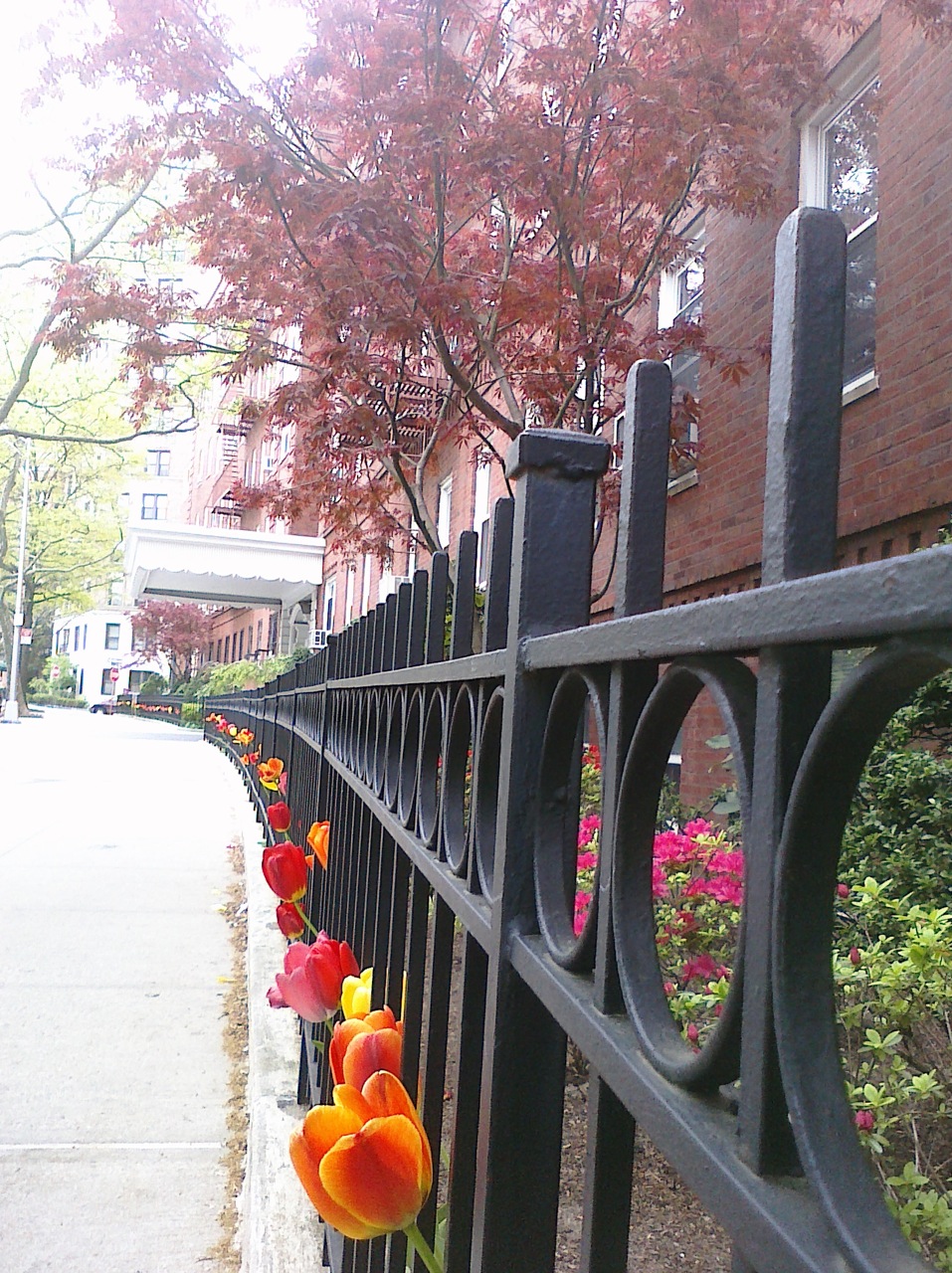
Is it just fine to spend this moment focused on the trembling leaf outside my window? I can see the wind in its effects.  I see the terrible cold that stunted the earlier leaf buds on the ginko tree, yet I see the juicy green of the leaves that have unfolded at the very tips of the branches. So I consider Syrian refugees, and families that have been washed away by floods in East Texas, and I think of my students and am amazed at the level of focus as I say, "notice..." and "feel..."

I listen for their breathing and I can feel the way they share their energy, whether they mean to do it or not.

My heart has so few protective layers when I teach. I feel this time of year like the growth of new skin on my finger tips. I am like the cucumber seedlings on my windowsill.  Each tendril on the cucumber plants seeks something to support it -- wrapping around the stem of its neighbor, or the stick nearby, or simply reaching out into the unknown to see what it touches, not caring too much if it is a fence, a stick or a weed. Aren't we just like that too, until we curl back towards ourselves in protection or just stick with what we know?

Can't we simply sit in the fading evening light and take both delight and sorrow in the trembling leaf? Of course we can. And it helps to know that others can give themselves permission to do this too. I can say in this blog, however public that may or may not be, that it is fine with me if you do likewise. No matter who you are, where you live, who you love, what you are fleeing, or how you dream.

Wednesday, April 10, 2013

Walk the Dog, Even if the Dog is You (Subtitle: Making Time for Asana and Meditation)

My father died as an old man, a month shy of 90 years old. Right up until the event that hospitalized him, he was responsible for walking the dog morning and evening. This assignment got him up and out into the world, among neighbors, into the forested walkways and power line cut throughs near his suburban home, where he observed the changing seasons and configurations of wildlife, erosion and wildflowers. This established a routine which was accepted by his wife, who was cognitively impaired, because she knew that he would walk the dog and return. This open space in his morning was not part of the plan on his own behalf, but it was critical to his well being.  The evening walk was usually shorter, and depending upon how heavily dinner sat in his belly, he would take on a small uphill under the streetlights. He would notice the moon phases, the silhouettes of trees, the other passing dog walkers and again have a moment to himself. His mind relaxed and contemplated all manner of things when he was out with the dog and he might take time to relax the constant vigilance his wife's care required.  Without the dog, there would have been none of that in his days or nights.

How much we are willing to do for the wellbeing of another varies from person to person, but many of us will take on tasks of cooking meals, walking dogs, running errands, taking on jobs and all manner of responsibilities to benefit those we care about.  Can we program each day with the time to take care of our self?

A personal practice, whether yoga or meditation, requires the same approach as walking the dog. It doesn't matter what the weather is, or how late you were up last night, that wet nose is there in your face to say, "Aren't we going now?" Imagine that in your practice you are both the dog and the dog-walker. Giving yourself the time, the open space, the exercise of those internal muscles of awareness, and most of all, the care you deserve for experiencing well being and connecting to the world around and within you. And as with a simple walk, it can be a half hour in the morning, or evening, enough to separate yourself from the patterns of the day and place yourself squarely in the center of your own attention. Neither the dog nor the dog walker requires a two hour commitment that pushes into your other obligations and activities. Nor can this unspoken contract of care and attention between you and yourself be skipped without consequence. One simply cannot say to the dog, "not today."  Imagine that your health and well being relies upon that half hour, and see your self staring at you with that query of "Are we going now?"

Friday, December 21, 2012

These tools remain accessible.


Where there is meaning, there is silence.


Sounds causing waves of reaction, interaction, conditions.

Words sink in so deep, all I hear is the space over them.

That rolling movie of my mind remains projecting on the wall of the skull, a light show.

The feeling of warm hand on thigh completes my form.

Exhales join the inhales in the air around me, no questions asked or answered.

Even the music of my heart runs into itself like water into water, indivisible.

This open to being, being opens,  understanding without tricks and illusions.

The candle flame consumed in continuous transformation.


Friday, November 16, 2012

Music & Silence

Breathing. This is the sound I hear of oceans and wind, of expansions and contractions. Releasing whispers. Releasing sighs. When I teach, I most often use music as a way of shifting the orientation of my students away from the external world and into their own energy lines and their own bodies, yet music remains external. It is like a prop that helps extend your spine by lifting your hand on a block, the music disappears and reappears when you need it. That is, if it is doing what I hope it is doing. Music can work against the inner rhythms at times, a mood introduced with words or associations that is distinct from the practice. Yet often a person will not even know what the music was during a class, and simply flow along. There is so much going on, after all.

Yet practice in silence is so deeply tuned to the breath in the body, that I begin to wonder how we ever practice with music at all. The sounds of others breathing can be more powerful and supportive than the music, encouragement to deepen, to let it go, and to feel less isolated. Of course sometimes those exotic sighs from across the room will be distracting! Or that particularly vibrant Ujjayi sound will introduce doubts about one's own quiet waves...

I am not one sided on this, and find music in classes can bring flow and sustain effort, ease tension and even tease out humor in a tough moment. But I am not listening to the music as I teach. Truthfully I hear it when it distracts me, when it intrudes into the silence. I feel it settle the students into the closing asana as we prepare for Savasana, and then I want deep quiet for them.


Saturday, September 29, 2012

internal discipline: not a routine matter

Every day I brush my teeth twice. I've done this for at least 50 years, not able to account for the first 8 in which I bet I only brushed in the morning since dental hygiene didn't have the ubiquitous commercial value it has since accrued. In a way, teeth brushing is part of the routine of my days no matter where I am, or what is on my schedule, both of which fluctuate regularly.  I'm present when I'm brushing, noticing what's going on, but for the most part I'm just getting it done before heading off into the day or off to bed.  This is not a matter of internal discipline, but of external routine put into place for my dental health and sense of wellbeing... I am not a hermit after all, and my mouth has a part in my social behavior.

Meditation is not the same as brushing teeth, though I've had lots of people give advice to set a specific time of day and to routinize the behavior of taking the seat of mindfulness.  I know others for whom this is a way of life, but for me at this stage anyway, the routinizing of time of day isn't happening. Surely I could schedule meditation like tooth brushing and just get it done, but it isn't in my life as a daily obligation.

Meditation is, for me, an exquisite exercise in internal discipline, a matter of choice. I do not sit in order to say, "check, done that." I do not sit in order to see how long I can sit today as opposed to how long I sat yesterday or last week or last month. There is no measure for me, no goal, no established procedure.  There is no amount of sitting that gets me where I have to go.  Many might argue that mine is not a discipline at all, being so open ended, so haphazard. Separating routine from discipline seems to be part of my practice.

Unpredictability, curiosity and the swinging pendulum of joy and sorrow all drive my practice into its daily form. Taking the time when it presents itself, and organizing my days so that that time does present itself are tandem skill sets that are always in development. Failure in either of these is deeply felt and motivates me more. Like bringing yoga off the mat, this brings meditation off the cushion for me.

My practice is fueled by unpredictability, curiosity and that swinging pendulum. It is not a book that I pick up and find my bookmark and begin from where I left off.  All I ever have is this very moment. My tight left quadriceps might rule the world one morning, or my reactivity to the daily news, or the catching of my breath in my mid lungs, or the expansion of my energy beyond my skin. There is no way to predict the multiplex of movies that will be running in my mind, or the syncopated rhythms of the world around me. I have no interest in avoiding those elements, but rather seek it all out of a deep curiosity for the entirety of being present.

I am not attempting to psychoanalyze myself for 30 minutes,  to placate my emotions for 20 minutes, neutralize my political leanings in 10 minutes, nor solve my schedule conflicts in 5 minutes of silent sitting.  I never hold still in my seat; awareness of my breath moves me, continuously reminding me that I am alive in this very moment.

Developing this level of internal discipline is a great challenge, but that is what calls me to my practice. I don't expect to be a better person, or even a calmer person, as I have set aside these along with other expectations as my practice develops. My most cherished moments are the ones with no expectations and no boundaries, no interpretations of what arises, no way to leave off and bookmark it.  Success for me in this expenditure of time and energy is, I suppose, how I continue living my life fueled by just this unpredictability, curiosity and my own swinging on the pendulum of joy and sorrow. Meditation has intensified my awareness, eliminating many lines I had thought were boundary lines, as they either vanished into the mist, or emerged as entirely different structural elements.

My little local yoga studio, Shambhala Yoga & Dance Center, in Prospect Heights, Brooklyn, (where I lead a 20 minute meditation from 5-5:20pm on Tuesdays before teaching a beginners yoga class) is planning to embark on its first meditation intensive experience. Several of us who teach at the Center are considering this and preparing ourselves to help structure and support a month of days of meditation practice among our fellow teachers and students. This preparation has me looking at my own practice from a more structural point of view, and thinking about how to share this ever-beginning again practice with others.  I am grateful for the spotlight on this in my own life, and am interested to see what turns up!

Friday, September 28, 2012

Growing Solo: Skills in Class, Explored in Private

Yoga classes are where I learned to see myself through the actual experience of being myself. I felt my resistance to external direction; I recognized deep inner sorrows; I discovered flexibility and habitual patterns. Over time, every bit of this moved off the mat into my daily life, relationships, self definitions.  On a grand scale of patterning I was shifting and changing, but the minutia upon which the patterns all relied was discovered only in my personal practice. Allowing the experiences on the mat to go where they led themselves, taking on the challenges of body and mind that arose from my own body and mind.  Classes will give you the tools for this, but only the personal practice gives you the opportunity.

An example of this might be a reluctance to kick up into handstand with "the other leg." It is one of those moments in private when you face your drive, your judgment, your fear of failure and the pain of that. You can seek out the mechanisms by which the body can actually support the move, rather than throw the body into the panic again and again until it somehow "works." You can deconstruct and reinvent the pattern in the movement, and without a care about the handstand, discover the rising into it. Feeling pain in class in a joint or in a movement, you will quite simply try to avoid it the next time. In private practice you can explore the sources to support safe movement, or to genuinely protect the point in jeopardy.  You can evolve the practice from the foundation into the pose or movement, building the resilience and awareness that bring you fully into the pose rather than aiming for the shape of the asana. Strength and stamina can be built, and the self defined differently.

Meditation practice requires a most intimate connection to solitary practice. In a group of people, meditation puts you directly in touch with your own mind and habits of mind.  The group can support you with community, scheduling, breath around you, and a little pressure to keep your seat out of shame or anxiety.  A group can even offer you material to work with in the form of distraction and dharma themes upon which to focus your thinking.  It is in your own practice where you find the threads with which you have been spinning the stories, and where you can stop that spinning and can observe the threads, and the stories, without having to give over to watching them.


Saturday, June 9, 2012

Escalating Practice: Encouraging or Lost in Ego?


It is nearly impossible to ignore the sparkle of doing more, the allure of the challenge in the physical asana, or the hierarchy of yoga classes and practices deemed a "higher level." We all see yoga in the external images, those crowning aspects of back bends and inversions that seem so graceful yet unapproachable to so many of us. Without exception, we can find ourselves in classes with bodies that seem more able than our own, or at the very least, we know of such classes labeled "advanced." Is this how we deepen our practice, inspired and driven beyond our current limitations? If not for setting a goal of building strength, or gaining flexibility, or holding steady through that moment when we want to give up, how else do we get beyond feeling weak, inept and unsure of ourselves?

The way I see it, the very first commitment we make to our practice is a step beyond this allure of escalation. Embedded in that first commitment is an inkling of non-dualistic thinking: that even with our flaws and weaknesses, strengths and proclivities, we can experience the truth of this moment and release our judging mind into the role of observer/witness. Even as we struggle in the first moments of a meditative centering, even as we worry about our tight hamstrings in a forward fold or weak abdominal muscles or sore wrists or tight lower back or whatever it is, we can begin to see it as it is and with a focus on this inhale and exhale we can allow ourself the experience of observing as our own awareness begins to broaden. This is the heart of practice at any stage, after any number of years. If you began the practice as an accomplished athlete in perfect physical form, you would still run right up against this greatest challenge: to be fully present in a broadened perception with a focus of awareness in this moment.

And so it is that I find myself too, right in the middle of standing on my head, and up until a specific moment, my energy is flowing freely and I am observing an array of sensations, including an openness and startling ease. Then, in an instant, my attention turns entirely to counting my breaths, and my mind establishes a goal -- that number of breaths that would put me in the "I DID IT" category. My experience of the moment is hijacked into holding on tight, counting my breaths and encouraging myself to just keep going until I reach that magic number that I've set myself. I hold on for that accomplishment and when I do release from the posture, I pause, observing the flow of energy in response to the asana, the sweep of the experience and my breath in that moment.

Is it any surprise that my practice was to see the grasping at the goal, after experiencing a new level of openness in the asana? Not at all. This is the essence of the practice itself, declining the invitation to escalate into a physical competition, inviting the increase in awareness of what is actually happening, and as always, seeing the dualistic way of thinking/being and not getting lost there. The significance in the number of breaths I remained in headstand is indeed in the experience of that gripping, my fear reaction to the openness in the pose, that by its very nature challenged everything about the status quo of my conditioned ways of seeing myself in the world. So much benefit in perceiving the choices of where we turn our attention! So much freedom comes in those choices!

Tuesday, March 13, 2012

Consider the Pearl, A Meditation


Swaying between the pulling tides of hope and fear,
we balance.
Our weight on the earth,
sitting bones softening deep into the support beneath
the spine, spacious and rising into the endless sky.

Allowing the jaw to loosen, even
the muscles in the shins go slack.
We balance the weight of the head
over the beating heart.

Consider yourself a pearl lost in the grass.
You sitting here.
Your skin a container for your inhale,
your shape ever changing.

Consider the pearl lost in the grass.
Like the dew drop resting on a leaf,
its membrane like a skin,
its clarity and translucence, ever reflecting.

We balance between hope and fear,
between the earth
and the endless sky.
Between the pearl's luminous solidity
and iridescent illusion of the dew.

Wednesday, January 25, 2012

Warrior Walking


This morning after teaching, I experienced a remarkable synthesis of yoga and the moment in daily life. Walking home there was a saturated feeling of soft support of my bones through my contact with the earth, spaciousness in the joints of my hips and shoulders as I moved, a wide open quality in my view of the urban scene around me. There was joyousness balanced with stillness in my thoughts. I recognized this sensation as that of Virabhadrasana, the warrior, in my yoga practice. I was startled to find myself a walking warrior on the streets of Brooklyn!

What really awakens in the warrior poses? Can the gaze be soft and inclusive? Does the support felt in the foundation of the earth allow a subtle rising energy that is alert and poised? Where does the breath expand, what is releasing? Where does the mind grasp, find clarity? Can there be spaciousness in the joints and a balance of effort and ease that prepares you for whatever is around you? All of this can be going on at the same time in all of the three traditional standing warrior poses, Virabhadrasana I, II, and III.

The subtleties are in the cultivating of your awareness to enable you to take in the muscular work, the alignment of the structural elements, the softening of the edges and the gaze, the placement of the breath as a buoyant support for staying in the present moment. This allow you to stay present, not blanking out or fading away. Often in classes students are led through a vinyasa that takes them through one warrior into and out of another. In that experience there can be a collaboration of stillness and movement if the student can let go of gripping, yet hold steady to alignment and ease throughout the muscular and joint shifts. This is really not a simple endeavor, and often I see students physically muscling their way from here to there and back again. Of course a yoga practice often begins right there, at the junction of the physical and the alert awareness that effort can spark.

Experiment with remaining in the asana, exploring your own experiences in the moment, and see if you can struggle less, effort less, and notice more. Take out an element, perhaps the uplifted arms, and discover what is happening with your bones and breath. Acknowledge the emotions and the patterns that effort and resistance might bring up. See if you can soften more by attending to the quality of your breath. Then, perhaps add the arms back into your pose. Can you express the open gaze and steady heart of the warrior through the soft expansion of your collarbones from the soft center at the base of your throat all the way out to your fingertips?

Thursday, December 22, 2011

Applying the Practice


I look out the window and see the bare hills, the dark leafless trees, the bright gray cloudy sky. Birds are busy at the feeders, and though I am North now, I know that there are roses still budded and blooming in Brooklyn. Today the winter's day will shift into the longest winter night and from here on the daylight grows by tiny increments. Mild temperatures and moisture could fool me easily into imagining it is early April and Spring is around the corner.

But that is not so. Choosing an image for a season's greetings, my husband and I agreed on a deeply snowy image.

My elderly mother-in-law is no longer traveling and so, my closest clan of four will transport ourselves to spend this next weekend together with her and my sister-and-brother-in-law. This makes me feel happy and grateful even as I pack a bag and try to organize for departure. Convenience and ease are not the reasons I exist on earth. I am acutely aware that there is no knowing what comes next, and there is virtually no point in imagining what the next winter solstice will bring, snow or blooming roses.


Sadness washes through my system with regularity these days. I feel a turning of my gaze towards the faces that are no longer here with me, and the small actions of preparing for the ritualized holiday season bring up the softly dark spaces once occupied by people dear to me. Last year I did not know they would be gone now, and here in this moment, I can allow the feelings to arise, see them for what they are -- love and longing, appreciation and gratitude -- and go on about putting candles around the house. I do not try to push the feelings away, ignore them, or feel sorry for myself. I simply feel the feelings, as energy arising around my heart and filling my mind with memories that add a dimension to everything I am doing.

In meditation teaching I often say that we are not trying to erase or stop ourselves, correct or change ourselves. We are making the space to see ourselves, experience our self and begin to explore possibilities that are otherwise drowned out by the constant shifting and noisiness of mind and reactive nature. On the mat, the yoga asana flows from physical effort to an understanding of energy and attention.

At this time of year, it seems these practices come directly into my every day moments. I am not on the mat, I am in the kitchen preparing for a family meal, remembering turning my hands towards other meals. I am not quietly sitting on a cushion, I am sitting in a zooming crowded car on a busy interstate highway. It is even more amazing to open up my awareness and focus my attention in these contexts. I feel the sadness, nod at it and let it slide past like the blur of exposed tree limbs. I am glad to be on my way, and there are roads I no longer need to travel. It is complicated to understand this delicate balance of love and loss. The first aspect is to go ahead and feel it, notice it, see what it is. So I use my asana practice here too, to be present in body and energy, connected beyond the reactive state of mind and filling with joy.

Wednesday, December 14, 2011

Back to Basics Again


There is a constant cascade of words, feelings, sensations, ideas, memories and sounds. I could be watching a student breathing, or riding on a subway, or drifting in and out of sleep and this would still be so. Somehow there are ways to narrow the focus of attention and at the same time open up levels of awareness. It turns out that it never works to try to shut all this down, turn it off, ignore it, block it out. The only thing that works is to open awareness even wider so that, in some way, all this billowing, thrashing, distracting material becomes just a very small bit in a much much more vast expanse.

Sounds unbelievable even to me, and yet, if the breath is the raft and my attention is floating on that, everything else is just part of the ocean.

So sometimes the swells are noticeable, or a wave crashes in and totally pulls me away from the breath. The funny thing is that it doesn't matter at all, because I can smile at this (or not even react beyond noticing that it happened) and turn my attention right back to my breath. Not getting sucked into judging the situation, or hanging on to the idea or the feeling that splashed onto my raft and caught my attention, I lose nothing.

Who is measuring how many times I climb back onto my breath-raft? Who is laughing at the object that managed to pull me off? Just me, all me, not me at all. There is a swirl of energy around my breath that contains everything -- that which will distract me and that which grounds me. The ability to focus my attention gradually gets stronger, more able, more adaptable to the movements of words, feelings, sensations, reactions in general and conditions in particular.

So I come back to the most basic practice again and again: simplify, experience, abide. And it is the breath that takes me, follows me, holds me, sends me, returns me and enables me to play this game at all of observing and being my self.

Friday, November 18, 2011

All that is solid melts into breath


The breath has a way of discovering space, just as the air itself seems to find the smallest crack or most enormous canyon. It has been seeming to me lately that my practice and my teaching are growing from this discovery. Directly. My ability to notice the breath, or be aware of it, has encouraged an internal investigation among all my own cells... and this branches out into everything I do.

So when I take a yoga class, I follow directions, just like my students do in my classes. Yet what I experience is my breath slipping under my shoulder blades, no matter whether the teacher says "lift your breastbone" or "press into your heels" or "reach for the ceiling." In some cases there are other sensations, the pulling and twisting, the pressures, and collapses of interior spaces or bones, or muscles, or ideas. I walk on the sidewalk feeling signals from all the points of the body, full of reactive chatter, and the breath quietly expands beneath my ribs, swinging my pelvis just a little this way, and releases my throat as my pelvis quietly swings just a little that way on the exhale...

I am beginning to understand something.
It starts with noticing.
Expands into observing and alertness around what I notice.
Then I sort and contemplate the rising ideas and reactions, eventually letting them all slip out on the exhale.

And I begin to notice that I am understanding something.
This expands into examination and inquiry into what I notice.
Eventually I release what I think I understand and experience my breath quietly slipping between the hairs in my nostrils.

When I can no longer enable my breath to investigate and expand my awareness, I believe I'll be ready to leave this body and try something else.

And so, as usual, I bow to that which sustains me. Om Namo Bhagavate Vasudevaya.

Saturday, October 22, 2011

Being: A Balancing Pose of Bones & Breath


Lately I've been balancing in an open space, where ego defines the self and awareness enables no self. It has been hard to rationalize writing in this blog, as though I hold some kernel or seed, acting to share its potential and growth by posting in cyberspace. This tends to lean a little too far towards ego and I lose my balance. Yet I seek experience in my body -- the practice of yoga, the making and eating of meals -- to validate an existence that is totally normal and real and designed around accommodating ego. Then I meditate and sometimes lean a little far into no self, finding a vastness continues to open that is still unfamiliar and surprising.

The temptation to meditate is leading me towards compassionate action as well as withdrawal from the senses. Walking, teaching, studying, interacting, I can operate from vital energies emerging from that vast open space. But I remain an individual ego - opinionated, full of feeling, clutching at experiences and reveling in reactions.

In these days of lengthening darkness, I cherish those boundary moments when deep awareness saturates, and there is no understanding at all of a defined named sort. Dawn and dusk seem to embody this sensation even as the brightness of day and the layered shadows of night thrill me. I continue to revisit the moment in the hospital when my father and I mutually arrived at the boundary between his living and his dying. It was wide, vast, endless and precise. Universal and personal. Everything was present - fear, love, unknown and known, hope, grief, but the deepest sense was vastness and utter connectedness.

So I've neglected the blog. This has also been clarifying since I let go of defining it. I have been keeping a journal of notes that speak in words - telling of experience or observation or feeling or idea. Journal perhaps acting the role of non-judgmental, all-accepting intelligent parent. Journal as wise, kind, compassionate teacher. Journal as interested and disinterested, informed companion. Not much influence on what arises, the blank or scribbled open page.

Monday, August 1, 2011

Here Today, Here Now


I am puzzling over the odd illusion that I get things done, that there is an endpoint, that I do something until it is finished. There is great resistance in me over giving this idea up, yet I clearly see it as "an idea." Even in the setting of a goal there is really only the doing. I might finish a meal and wash the dishes but I am not done with eating. I may weed the garden but I am not done with gardening. I may hold headstand for a specific number of breaths but I am not done with headstand.

The lessons of the summer continue with every poppy and daylily bloom.

Living fully within the constraints of this very moment, not reaching into the future, nor grasping at the past, seems to require releasing this idea of "being done." It is not the same as leaving things unfinished, nor does it mean not accomplishing anything, but rather truly letting go of results. I think humans quite naturally construct beginnings and ends for emotional and psychological convenience and to feed the illusion of certainty that we find so comforting. It is a huge shift to loosen my grip on this way of understanding. Once I see it clearly, it seems to have pervaded everything.

Moments of being offer me great freedom from this clutching. In those moments when I can fully be in-the-being mode rather than in the doing-to-get-done mode, there is even greater happiness than from the illusory constructs. But my oh my how I do fight against this! That is where practice makes all the difference. Plodding along, moment by moment in meditation or a yoga session or in the garden, or the kitchen, or with a list, or in conversation, or contemplating my calendar, I can actively see my tendencies and practice loosening the grip.

Sunday, February 20, 2011

This Asana is Contraindicated for ...


me, and yet I practice. Listening to my own arguments, I hear fear and I hear determination. There is goal setting and there is wishful thinking. There is regret and self-doubt, and there is hopefulness and curiosity.

When I began practicing yoga I took any class that fit in my schedule. I was approaching 50 years old and I knew less than nothing about the lineage, names of luminaries, history, even potential health benefits. I didn't even know what shape I was aiming for in the Asana of the moment. I listened deeply, worried on the surface about mixing up my right from my left, and began breathing into a new space of awareness inside.

This fall my practice will be much the same as it was 10 years ago... I will be discovering that I can change the angle of my lower spine by remembering my big toe, and I will use the wall to prepare for Ustrasana (camel pose) just to see how much energy I can raise from my Tadasana (mountain pose) knees. There are many Asana I can explore in my practice, and of course, my practice does now include teaching which is a magnitude of exploration I could not have imagined in those first few experiences.

Every Asana has benefits that reach into the basic functioning of the body -- circulation, nervous system, muscular strength and flexibility; and the mind -- judgment, intention, challenge, determination, curiosity, resilience and focus; and the organs -- etc. Every asana has contraindicated conditions, for example shoulder or ankle injury, stages of pregnancy, frailty of bone, uncontrolled high blood pressure, etc.

As a teacher I may mention a few of the "if you have this, modify in this way" instructions, but I find it hard to say, "just don't do this." I find it especially hard to say it to myself. At the moment, I have two physical variables that would contraindicate nearly everything I do in my yoga Asana practice -- including what might seem simple like sitting in a cross-legged position.

So here is the secret: Do not hurt yourself. Follow the path of the breath and prepare your physical body for practice with an open mental attitude of exploration rather than goals and end results. Use props and find out what is actually happening in as full a way as you can in that moment. It is not getting into the full pose of Ustrasana that will help you if you have low back issues or rotator cuff problems. Yet many of the steps along the way will be exactly what your body can best use to mobilize, stabilize and strengthen, stretch and explore.

It is the mind that wants to take the full expression of Urdhva Dhanurasana (Wheel). Deepening and exploring a supported heart opener over a bolster or block, or using blocks to support your sacrum and your upper back in Setu Bhandhasana (Bridge pose) will give you more possibilities to experience your life than you could imagine.

So it can really help to find a teacher who can help guide your practice into the deepest places you can explore, and slow things down, rather than attending classes that continually show you what you can do to hurt yourself. It helps when you don't believe that everything rests in the final pose, and keep an open mind about what might open your practice.

Saturday, January 29, 2011

When Things Seem So Much Farther Away


Halfway into the last snowstorm I noticed how all my normal errands seemed so much farther away. My yoga practice has seemed a bit like this too, since I sprained my ankle.

Turns out it is not really my body that puts long distance in my yoga practice, nor the snow piled on all sides that makes the local food co-op any farther away. It is all in my mind.

Making adjustments in yoga practice is a natural part of practice, and comes with the territory if you are going to practice on your own or in a class. Just because the teacher or the person next to you can lean on their wrist does not necessarily mean that you can... or put your heel down when squatting or lift your arm next to your ear. Each body comes with its own patterns and structures and it is more than half the amazement of a yoga practice to discover all this about the body you actually live in.

The same is true when injured or not feeling well, or under special natural conditions. A dear friend of mine is very near to the end of her pregnancy and just this last week ran into three specific movements in her yoga practice that had been fine last week but her body just said, "nope, skip that one this time." This indicator is helping her understand the deep changes taking place as her child prepares to emerge. My ankle tells me many stories even as I work into a seat for meditation! In this way, my teacher is always with me, drawing my attention to sensation, to the shift in the breath, to my own wandering awareness.

And of course my food co-op is right where it has always been, but the journey there and back has been brought sharply into focus as a moment-by-moment experience. I am making constant adjustments for my ankle, for the ice, for other passersby, for the beauty of the nearby fence all decorated in snow. How wonderful to be aware and alive! Of course I will be happy when the pain subsides even further, but do hope I can remember to notice when my attention shifts and many things seem closer while others move farther away.

Monday, November 22, 2010

Ahimsa & Judgments


There was a children's book my kids loved when they were little that was set up so that each page offered a “that’s bad” or a “that’s good” set of conditions. Each set of pages illustrated the same situation from a different point of view. Sometimes it was hard for my children to figure out at first why it was good, or why it was bad… and they delighted in turning the page to discover the instant reversal of fortune. There are many jokes and riddles like this as well. The biggest is the one we present to ourselves daily, reacting constantly to the conditions around us.

Seasonal change, holidays, markers like New Year’s or birthdays often seem to bring out the “that’s good – that’s bad” in us as we project and remember. We look ahead and say, “Oh no, this is going to be …” or perhaps “Phew, now we will be able to ….,” as if the mere fact that there is a next moment offers us a “good” or “bad” set of conditions. Of course some of the conditions we project or remember are related to economic hardships and climate, to physical conditions and types of community in which we live. Yet even with these conditions there are those whose basic approach is “now I can change everything from what it was,” while there are those whose attitude is “look how this will limit me.” We do not control conditions of the sun and seasons, the wind or the age of our bones, yet we do live with those conditions and have choices how and whether we react.

Here, where I live in the Northern Hemisphere, East Coast of the not-quite-New England United States, we leave behind the summer warmth, as we watch the vegetation lose its green vitality, drying through the phases of colors and textures until all becomes more starkly browns and russets against evergreens and stone. Days shorten, nights lengthen and the air cools, beginning to require layers of protection on our subtle, fragile flesh. Animals living outside in this changing world grow thicker coats of fur, fluff their feathers for insulation, bed down in nests and burrows, sometimes even turning down their own biological thermostats to better match the outside world. They do not judge the harshness or the coldness, the darkness or the lack of fresh greens. The adaptation to the physical world is as natural as the breath itself, and some do not survive the shifting seasons, either by design or by circumstance. We humans uniquely assign values.

It is deer hunting season in upstate New York, suddenly as of yesterday morning. The sounds of gunshots reverberate in the hills. I associate this sonorous punctuation with death and destruction. By late afternoon, driving to or from anywhere there are carcasses hanging from trees. It is a horrifying time for me from one point of view, yet the deer laying dead by the side of the road is also done with this life due to human behaviors, and the deer bones found in the field after the coyotes have finished with it is done with this life as well. It is my own mind, my own judgment that attaches the sense of horror, assigns attributes to the people who roam the hills with their powerful rifles aimed at another species. It seems different if they aim at our own species yet we, humans, do that too and assign a different value to that based on context and intention. We make rules about shooting deer, which some hunters keep and some do not, just as in the context of armed conflicts among ourselves. Some feel the rules are arbitrary, restrict their freedoms to act as they choose, or pin them down in situations where there is ambiguity of choice.

So as I approach Thanksgiving, I turn my own pages, “this is good” and “this is bad.” I watch my own predisposition to say “This is harm” and “This is natural,” and I find myself exploring the world of human intentions.

Do no harm, Ahimsa, is a basic fundamental part of yoga awareness and practice. It begins towards the self, towards other living beings, and in the way we offer our teachings, making all efforts to leave space for others to find themselves. How to apply Ahimsa to the porcupine chewing on my front porch, to the hunter from next door shooting off into the woods, to the broken hearted driver who realizes they have run over a darting squirrel? How to offer Ahimsa in a room full of older people who suffer from attachment to the memories of what they used to be able to do in bodies that no longer do those things? How to practice Ahimsa towards myself as I see my judgmental nature turning and twisting at the toll booth, the body of a dead deer strapped to the SUV roof next to my car?

The hunter from the hungry family who will hunt and shoot the deer, bringing home meat for the freezer to feed them all winter is not killing any differently than the sporting hunter seeking the 5th set of antlers to adorn the wall in their home. The death of the deer is not different. The intention is different. Why does this matter to me? Who am I to sit in judgment of the one or the other?

We make choices about what we do or we fall into patterns of habitual action. We can make choices about whether we judge something or not, and recognize the values we assign to our judgment. I do not foresee a time when I cease judging others or myself. Yet I come closer and closer to practicing Ahimsa in my judgments, leaving just a little more space for myself to choose right action, right speech. Perhaps this also makes a little more space for others to do that too.

Sunday, November 21, 2010

Not an Escape Hatch


Right in the middle of a hard time, I throw myself on the mat. Oh to clean out this mess in me, oh to just erase the hard stuff and feel peaceful. Why can't I just step outside this snarl by meditating and doing yoga?

Even though the practice is not an escape, my practice brings me closer in to what is going on, if I choose to allow that to happen. Meditation and yoga-on-the-mat practice does heal some of my internal wounds, and perhaps these inflammations and old gashes support the current mess. It can lead to the illusion that the practice helps me escape... because I feel so much more equanimity and space for my own breath in the practice. I can let my body unclench from its reactivity and that brings more energy to every situation, even the hard ones. Giving myself space can also change my entire view of what's going on.

So the impulse to throw myself into practice in order to escape and erase is also reactive nature, and though the result is not escape or erasure, the practice itself can help me step back and observe my own clenched hand, my own part in the story from whence the trapped feeling comes.

There are moments when my mind shuts down with the overload of information, when I cannot figure out what to do. There is a misconception that I must solve the problem. Practice helps me notice the specificity of my own posture. Where am I tightened up, where can I lean into the earth for support, how can I let go and make more space? This is the same approach that works best in the middle of a snarl. In its nature a relationship reaches beyond the individual components into a shared energy, an interaction. If I can find my own breath, feel my own foundation, free my own clenching, then there is a much better chance I can actually see and accept the conditions and reactivity around me with more than just tolerance.

My attachment to the outcome of the situation exacerbates the snarling, and my practice helps me see the source of my attachment. That, in and of itself, can set me free from the entrenched place where I was stuck, defending, attacking or drowning in confusion.

Practice, in its nature, helps me see that there is nothing "wrong" and nothing "right." This way of seeing what is, without judgment, eliminates the idea that "problem solving" is relevant or useful. By addressing my own attachments and judgments, I free myself to be more open to all the aspects of whatever the current brings in.

Practice, not to erase, not to escape, but with the possibility of seeing more and more clearly, being present even more fully. Using meditation and yoga will help, not to slip away and disappear, but step into more space for your awareness, for your compassion, for your intellect as well.

Thursday, November 11, 2010

Not So Special, Just Being Authentic


There is such a temptation to build ego! Even as the yoga practice works to dissolve the dualities, drawing attention to the energy rather than the definitions within which the energy moves... Meditation is walking in the wind, watching the world move in response, feeling it, and even while feeling it, letting the feeling slip out of the sensory realm.

Okay, so meditation can take a person beyond that ego, but the ego still wants in on it. You can feel it, hovering, wanting to get its sticky fingers back into the deliciousness. There's nothing wrong with ego. We need it, definitely, to function properly in the world. But it is not the same as being, it is the separate "self" rather than the universally connected "Self."

Taking a yoga class is a wonderful exercise for me. It is like the way your core feels when you first try to invert into headstand... all wobbly and strangely new. There's a sense of identity, yet an observing identity, and yet still another body of energy that is simple and clear. I have to laugh at the teacher person on the mat who is laughing at the student person on the mat who is laughing at the blissful energy person on the mat who is hovering over the aching knees and softened heart person. All of them are me and yet this does not make me into any thing, or any one in any hierarchy. Each body in the room has this fullness of knowing, not knowing, feeling, perceiving, and witnessing. How wonderful is that?

The fact is that nothing I do on the mat, or off the mat turns me into a pot of gold. I remain a breathing entity wobbling through the moments I get, sometimes lifted off the earth in a blissful state by a gust of wind in the leaves, sometimes slogging in the mud with a shovel made of the heaviest steel. And so it is for everyone, I suspect. We have our separate faces so we can tell better stories, otherwise we might be like bees and all there would be would be a sound of communal buzzing. Actually, some of the most marvelous moments are those when we listen for that very sound among us.

The big part of practice in this regard is to let go of my attachments to putting values on "me." It is not that I am worthless, but that there is no measurable entity when it comes to "being me." It doesn't matter if I can do a particular asana or not, or if it looks just so or not. This way of being without judgment means that I don't feel "special" in any way that elevates me beyond the other human beings (or frogs for that matter) around me in the mud of yoga practice. This helps me really be compassionate towards myself and others. We are all just riding this particular wave, even if we cannot distinguish this wave from any other. The riders who fall into it sooner are no less riders than those who are riding it still.

Wednesday, November 10, 2010

Judging the Falling Leaf


Walking in the detritus of Autumn. Traversing a landscape with piles of leaves, leaves blowing across the streets, swirled in corners against buildings, damp, dry, brilliant and crushed to brown soggy pulp. What a beautiful reminder of this constant cycle in which we all exist, that of our budding beginnings, coming into full leaf, pulsing with chlorophyll and the means of production to sustain life. Then at a certain moment, draining of that functional ability, turning into something of a different color, a flare marking our existence before detaching, letting loose from the juices of breath and voice, and drying, crackling, falling, drifting, rejoining the substance from which we came in the first place.

So what is beauty? What has value here? What is the meaning? Where is the kernel of justification for everything? Do these definitions and categories change anything about the bud, the green leaf, the tinged yellow, falling brown or decomposed leaf? It is natural for the mind to see the details and acknowledge attraction or repulsion -- does a rotting tomato appeal to you the way a red ripe one does? I don't think so, usually. But if you look without the judging as to whether you want to eat it or not, or touch it or not, perhaps you will see it within the confines of its own beauty.

Some practices put forth the contemplation of the dead as a way of understanding ourselves. To watch the decay of the body is a reminder that we are all one with the dust, one with the microbes and bacteria, one with the water flowing, the leaves falling, the next breath taken by someone else. It is a tough lesson to learn that way, and yet there is much beauty in it. The decay process is not ugly or beautiful, just as the brown leaf or the red leaf is not ugly or beautiful. It is the mind that makes it so. This judging mind is so often turned up to a high setting, aimed at ourselves or others, at each corner of the world in which we spend our days.

The yoga mat, or the site of any meditation, offers a place where for even a few moments you can contemplate letting go of the judgmental mind. Pick up a few leaves -- green, fall colors, brown -- and use them as a focal point for your practice. Let them suggest to you that judging them is a mindless inquiry. Seeing them is an awareness practice, can lead to single-pointed focus, and help you let go of pre-conceived ideas even of your body, your possibilities, your self. Allow yourself to feel the leaves as part of your own cycle, to feel your own beating heart as part of theirs.

I often feel the leaf in me as I drift to the earth for Savasana, not judging where I fall, noticing the support wherever I touch the earth, and feeling the lightness of my curling parts in the air, never minding the next gust of wind that takes me flying.