Showing posts with label judgmental mind. Show all posts

Sunday, March 17, 2013

Doing What You Are Doing, Step Into Being Who You Are

Acting with clarity and without judgment reflects a constancy of self, an acceptance of best intention, an ability to engage with what is right there to be done with good will. Even unpleasant tasks or what might seem insignificant situations are sustaining if we are not jamming our own switchboards the whole time with judgments and confusion.

When turning clear energy toward a task, there is a sense of flow to it. This could be organizing a meeting, in a cooking or writing project, teaching or taking a yoga class, working through a tax filing, accompanying someone on a task they must do, anything really. This attribute of engagement is not judgmental, this is not a conflicted state.

If I am not resisting what I am doing, there is very little separation between what I am doing and who I am. Quite a difference when there is resistance. The mind chatters about all that is not as it should be, makes constant recommendations about this task, other tasks, other people's actions or choices, what else I could be doing, should be doing, cannot be doing, and generally gets in the way of feeling satisfied with how the time was spent or with the task itself. This takes energy too, and just like physical friction from resistance, it burns up some of the energy turned toward the task itself. Wastes energy. Pulls the action in other directions, and in a very real way separates you from who you are by spinning a web of illusion around your action.

"I did the best I could," is a statement that reflects whatever judgment is in your mind about the task. It can be said with derision, with humility, with sorrow, with pride, with any kind of emotion, really.  The statement is infused with judgment. There could be an unspoken sense of "under the circumstances" that holds a form of apology, or excuse, or blame, or self-judgment. There might be a subtext that describes a wish to have accomplished more, or the idea that someone else would have done more or better.

When you put your undivided attention into a task it isn't about "best" of anything, it is what it is. It can be a big shift to be comfortable with doing what you are doing, and not ranking what you are doing.
This is authentic action, what could be called, "right action." Full on engagement with an open mind, not a judging mind. The way this feels is not compromised by mixed internal messages and scattered judgments of the self or others now or in the past tense. This is being present in the moment, as Thich Nhat Hahn says so simply, "wash the dishes to wash the dishes."

Doing what you are doing without internal conflict releases energy towards the task that otherwise gets subverted into judgments and resistance. Doing what you are doing builds the muscles of mindfulness that keep you present in the moment in which you are actually living. Doing what you are doing literally turns everyday life into a moving meditation, of focused attention and open possibilities of being who you are.

Tuesday, March 5, 2013

Thoughts of Snakes & Heart Breaks

I've thought before about the way a broken heart feels as though it just isn't working properly anymore, as though the shell around the form has broken open and everything is tender and at risk. Oddly enough I began thinking about this in terms of growth rather than destruction or disrepair. This morning I had the deepest feeling about snakes and the way they literally lose their skins in order to allow for growth. They do not mourn the old skin, truly a sense of non-attachment! Nor do they worry about the size or shape of the new -- no grasping!  This happens several times in their lifespan, as it does, seemingly in our own human life span whether we see it that way or not.

It is amazing to see a snake swallow its nutrition in the form of whole animals. I think of the long slow sustaining absorption process that takes place along the enormous length of its digestive track.  Could it be helpful to think of ourselves in this way, that these huge inputs require a long slow digestive fire to take in the full meanings and sustain our growth? It seems we far too often think we ought to know in an instant, or learn over night, or get the message that first time. I know from my own teenage journals that I really did experience much that led to insights only to go on and repeat the lesson until I was able to actually absorb the insight.  What if we give ourselves the benefits of time without judgment, using  the kernels of understanding as they break free from the mass?

And then there's that wild way that snakes move, always with strength and grace, yet more often than not, resting quietly absorbing the heat of the day, or breathing slowly in the coolness of shade. They spend much more time just being than being busy. Wouldn't this help us too?

I'm not saying that we are snakes, or that snakes are we (at least I don't think that's what I'm saying), but I do think we suffer far too much heartache without associating that ache with the growth it so often makes possible. No matter what kind of day I'm having, if someone near me allows me to see they are struggling, I feel the ache. Years after a loss, or a painful scene, the heart can revisit its old shapes and replay the cracking of what felt like the safety of the shell.  We do this in our sleep through dreams, we do this in a split second when the air smells a certain way, or the light hits the edge of a leaf. You know what I'm talking about. Our hearts are very open to being broken, to feeling soft and exposed. Perhaps this belies a suppleness we have overlooked.

We go to a movie and weep for the characters. We hear a voice singing of heartache and ours responds. (I think of Leonard Cohen's song "Hallelujah.") If we are not grasping at the past, are we yearning for the future?  Can we re-visit our snake ancestry and allow the cracking to open us to the self that is already there growing into who we already are?

I come back again and again to this kernel that broke clear:  I am not waiting for anything. I am already right here. If that is so, then nothing is broken and I have what I need to make of this moment all it can be. I can allow myself to let go of the cracking shards and truly break open.  Is this a frightening idea? It is so only if being more fully oneself is frightening. Isn't that where life expands? Filling in the new skin, growing into the new shape, and going on until the next cracks let the light in to see the soft, supple and unfettered heart?

Friday, December 28, 2012

A Pledge to Live with Paradox


I am living in a layered world of paradox. Without goal, without limiting myself to definitive closed-end attitudes, how can I act with quiet certainty and follow a path in any direction at all? It is absolutely required of me that I let go of grasping onto my life as a product to be produced in a certain way, or as a specific thing, in order to experience the true possibilities I might have. The only thing that protects me from feeling myself to be continuously on the edge of the abyss of meaninglessness is to accept that meaninglessness is an idea, like any other goal or product of the mind.

So I come to weightlessness, a weird sensation where there is no gripping at all. It disappears in an instant of panic, or certainty. As soon as I allow myself to attach to a feeling -- any feeling -- I am on the ground again. Feeling every bone, missing those I've lost, wondering who I am. This state of illusion is not comfortable either, seems so heavy, never resolves, though sometimes settles into a groove that I feel as familiar. That's when the old tapes begin playing all my stories; the criticisms and praises, sorrows and joys line themselves up.  This is of no use to me at all.

The important part for me now is to also let go of this paralysis, a sensation easily confused with not knowing, or uncertainty.  No amount of thinking is going to create certainty, the more I close in and nail down the structure around an idea, the less likely it is that it will lead to my liberation. The clarity and depth of inquiry provide the path, not so much the bits that turn up as I dig.

A neighbor of mine in upstate New York handed me a long list of ignorant unfounded sound bites as a rationale for his political negligence, social belligerence and protectionist gun-toting perspectives. I felt myself circle the bait, mouth open, but I closed my lips and smiled instead. "Then shoot me first," I said, smiling. I didn't have the will to say, "you must be terribly afraid and disappointed in your life,  your community, the choices we have all made together," or even "then I must be the enemy since I do vote, feel responsible for others and I do believe in peace."  I felt that he did not want to talk about that, he just wanted to bluster his way through this moment and go home. It is a role that he often plays. Part of me couldn't wait for him to leave, but part of me wished I could hold on long enough to reflect his anguish and let him know that I am not dismissing him, blind to his painful condition. We all make misinformed or fear-based choices sometimes, ones that endanger ourselves or others. I am no better than he.

How do we live side by side, with ourselves and each other? Tolerating the paradoxes, accepting the gripping and the weightlessness, until we get used to it. This is what takes practice. Months and years  of daily, weekly practice, over time we learn to change our own shape and accommodate all the thinking in order to operate directly from our energy source.  I can see the abyss, I can see the snow flakes filling the space between the hill on which I sit and the ridge across from me.  Like a blind cat, I step and explore, seeking information from outside my body in order to live in my fullest form in my body as it changes constantly.

What kind of resolution can I make to encourage myself in the coming days and months? Perhaps it all comes down to allowing myself the space to practice. Can I do that? Can you? Yes we can.

Monday, December 24, 2012

Anticipation


The plans have changed.
The weather shifted.
The gift did not arrive.
There was no solitary time to organize.
This didn't come out as hoped.

And yet, here it is, another morning.
Sky the color of reflected snow.
Enough water for a shower, and tea.

The guests are still sleeping.
The morning chores are done.
The gift is the moment.
Not waiting any more.


Sunday, October 14, 2012

Fear of the Compassionate Heart

my brother, as sketched by my father 1992
I woke up this morning flooded with softness, like the soft rainy day itself, holding thoughts of my cousin and her daughter in my heart. Before I even opened my eyes, my heart had melted. It felt as though waves of love could be sent to surround their eyes, their arms and hands, their words,  the spaces in which they moved their bodies. There was no reason why these two women should be in my mind at all, and in fact I haven't seen my cousin  in more than a year and a half, and have never met her 20+ year old daughter. They have been locked in a struggle for many years with debilitating psychological and emotional issues that have trapped them, literally, in the house, isolating them from social and emotional lives. Though my cousin goes to work, she can do nothing else; her daughter so fearful at all times that she forbids her mother from even allowing anyone to come to the house.  For more than 10 years this situation has been kept close to the vest, and I had no inkling of it. I saw my cousin so rarely, and she seemed to be connected to her work and always warm and kind towards me. My older sister maintained contact with this cousin since childhood as they were closer in age. A few months ago, my sister described this situation to me, detailing her observations and all the suggestions she had made, positing therapeutic strategies, all with a sense of hopelessness and sorrow.

Suffering.  There it is in a neighbor, a friend, a relative, in ourself. The urge rises to help, do something, fix something, give advice. A feeling of helplessness and sorrow washes in, an ocean of uselessness. Anger and frustration take hold, driven by a desire that conditions be changed, people behave differently, understandings shift, problems be solved.  Judgments and assessments abound. So imperfect, the situation or the self; so unsatisfactory, the conditions or the choices.

We all know how it is to stand in one place, take in the view and begin defining everything by what we see there. So it is with suffering.  We take a look at it, perhaps even a long look, and that view begins to settle into all the shapes of our feelings and reactions, our ideas and our behavior.  In any relationship, we can see the patterns of response and the collaborative nature of our view and our actions and feelings.

What if there is no action to take? How do we open ourselves to simply acknowledge without judging and hold the depth of the hurt, sorrow, anger, frustration or pain of the situation? What would happen if we could actually just allow the entirety of it (that pattern or story or set of conditions) to open up in our awareness, to be truly seen - the sheer pain of it might be unbearable, debilitate us or drive us over the cliff! It might show us how powerless we are, or ignorant or just hurt too much.  It can be very frightening to let the truth in, precisely because there might not be anything we can do about it.

This is fear of our own compassionate heart. As in a sitting meditation when for a split second there are no boundaries to the self, it can be so liberating that we react by grasping for our defined self to reassure ourself that "we exist" as we have always thought. What if it is truly so that our existence is a series of structures that we have built with conditions and reactions and once seen as separate from our basic being we are free? It can take a while to see that grasping at our definitions is something we can let go, and allow the feeling of grasping to be seen but not be in charge of defining us. This is a practice of learning to abide, to hold that vast open sense of being.

Holding my cousin and her daughter in my heart with compassion, I go through the same sequence -- feeling myself grasping at what action to take, how to convey my thoughts or advice, even simply figuring out how to show my cousin that I care about her -- and allow myself to let all that go. It takes practice to open the compassionate heart without attachment to outcomes, or assigning responsibilities. For me, perhaps especially as one who has been responsible for taking care of other people, there are knee-jerk reactions in that direction and fears of what taking on those responsibilities could be for me. I watch myself worry over what might happen if I showed my open heart -- how much more pain might flood in! It is at that point when the boundaries vanish, and all my thoughts, reactions, judgments and fears can be seen for the conditioned patterns that they are, not rooted in this moment and not attached to compassion itself.  It cannot hurt me to open my heart, the source of the pain is not my compassion.

Perhaps I truly do wish that the situation was different for my cousin and her daughter. I surely wish they could escape from the trap that cages them away from what looks like happiness and a full life. My discomfort with the pain of others' suffering stems from my own ideas about suffering and my definitions of who I am and what I ought to do to alleviate that suffering. It is by overcoming the fear of my own compassionate heart that I can offer a truthful place for my own feelings, and a healing space for the suffering of others.

Friday, September 28, 2012

Growing Solo: Skills in Class, Explored in Private

Yoga classes are where I learned to see myself through the actual experience of being myself. I felt my resistance to external direction; I recognized deep inner sorrows; I discovered flexibility and habitual patterns. Over time, every bit of this moved off the mat into my daily life, relationships, self definitions.  On a grand scale of patterning I was shifting and changing, but the minutia upon which the patterns all relied was discovered only in my personal practice. Allowing the experiences on the mat to go where they led themselves, taking on the challenges of body and mind that arose from my own body and mind.  Classes will give you the tools for this, but only the personal practice gives you the opportunity.

An example of this might be a reluctance to kick up into handstand with "the other leg." It is one of those moments in private when you face your drive, your judgment, your fear of failure and the pain of that. You can seek out the mechanisms by which the body can actually support the move, rather than throw the body into the panic again and again until it somehow "works." You can deconstruct and reinvent the pattern in the movement, and without a care about the handstand, discover the rising into it. Feeling pain in class in a joint or in a movement, you will quite simply try to avoid it the next time. In private practice you can explore the sources to support safe movement, or to genuinely protect the point in jeopardy.  You can evolve the practice from the foundation into the pose or movement, building the resilience and awareness that bring you fully into the pose rather than aiming for the shape of the asana. Strength and stamina can be built, and the self defined differently.

Meditation practice requires a most intimate connection to solitary practice. In a group of people, meditation puts you directly in touch with your own mind and habits of mind.  The group can support you with community, scheduling, breath around you, and a little pressure to keep your seat out of shame or anxiety.  A group can even offer you material to work with in the form of distraction and dharma themes upon which to focus your thinking.  It is in your own practice where you find the threads with which you have been spinning the stories, and where you can stop that spinning and can observe the threads, and the stories, without having to give over to watching them.


Saturday, June 9, 2012

Escalating Practice: Encouraging or Lost in Ego?


It is nearly impossible to ignore the sparkle of doing more, the allure of the challenge in the physical asana, or the hierarchy of yoga classes and practices deemed a "higher level." We all see yoga in the external images, those crowning aspects of back bends and inversions that seem so graceful yet unapproachable to so many of us. Without exception, we can find ourselves in classes with bodies that seem more able than our own, or at the very least, we know of such classes labeled "advanced." Is this how we deepen our practice, inspired and driven beyond our current limitations? If not for setting a goal of building strength, or gaining flexibility, or holding steady through that moment when we want to give up, how else do we get beyond feeling weak, inept and unsure of ourselves?

The way I see it, the very first commitment we make to our practice is a step beyond this allure of escalation. Embedded in that first commitment is an inkling of non-dualistic thinking: that even with our flaws and weaknesses, strengths and proclivities, we can experience the truth of this moment and release our judging mind into the role of observer/witness. Even as we struggle in the first moments of a meditative centering, even as we worry about our tight hamstrings in a forward fold or weak abdominal muscles or sore wrists or tight lower back or whatever it is, we can begin to see it as it is and with a focus on this inhale and exhale we can allow ourself the experience of observing as our own awareness begins to broaden. This is the heart of practice at any stage, after any number of years. If you began the practice as an accomplished athlete in perfect physical form, you would still run right up against this greatest challenge: to be fully present in a broadened perception with a focus of awareness in this moment.

And so it is that I find myself too, right in the middle of standing on my head, and up until a specific moment, my energy is flowing freely and I am observing an array of sensations, including an openness and startling ease. Then, in an instant, my attention turns entirely to counting my breaths, and my mind establishes a goal -- that number of breaths that would put me in the "I DID IT" category. My experience of the moment is hijacked into holding on tight, counting my breaths and encouraging myself to just keep going until I reach that magic number that I've set myself. I hold on for that accomplishment and when I do release from the posture, I pause, observing the flow of energy in response to the asana, the sweep of the experience and my breath in that moment.

Is it any surprise that my practice was to see the grasping at the goal, after experiencing a new level of openness in the asana? Not at all. This is the essence of the practice itself, declining the invitation to escalate into a physical competition, inviting the increase in awareness of what is actually happening, and as always, seeing the dualistic way of thinking/being and not getting lost there. The significance in the number of breaths I remained in headstand is indeed in the experience of that gripping, my fear reaction to the openness in the pose, that by its very nature challenged everything about the status quo of my conditioned ways of seeing myself in the world. So much benefit in perceiving the choices of where we turn our attention! So much freedom comes in those choices!

Sunday, May 6, 2012

Ahimsa & Non-Attachment

Judgmental thinking is by its nature negative, isn't it? Every time I think, "I ought to be doing x-y-z," or "I can't x-y-z," I am in a small way judging what I am doing. The idea that there is something other than what is so, other than what I am actually doing, that would be "better" for me to do, reeks of wishing I was other than what/who I am. This is harmful to me. It is not the same thing as choosing to do something different; it is negative thinking about what I am doing. It seems small and without substance most of the time, but it reaches deeply into devaluing the self. There is a sense of insufficiency, of making mistakes, that the thought or act is not the "right" thought or act. Attaching judgment like this to the self leaves little room for acceptance and the growth that naturally occurs when those "good/bad/should have" barriers to possibility are left open.

I felt joyous this morning, and noticed that with surprise and amusement since today is the first anniversary of my father's death, one week after my mother's death last year. How was I "supposed" to feel? The sun lit up the dew on the grass, illuminating the delicate petals of the crabapple against the intense blue sky. Images of the hospital room appeared in my memory, of those last hours at my Dad's side, in which we gazed into each other acknowledging the transition taking place. Nodding at this as memory, knowing the physical man is gone, I walked into the kitchen and began cutting the one grapefruit remaining in the refrigerator. It was an unplanned celebration. Every morning my father's morning ritual was just this, a half a grapefruit or a slice of melon depending upon the season. A deep pleasure filled me, relishing being alive as the flavor burst forth in my mouth. I remember him telling me that it was that first bite of grapefruit that would get him out of bed in the morning.

Perhaps on this day I "ought to be" sad, and there are moments in any day when I find that can be the dominant feeling, yet I am essentially grateful for this human experience in its fullness. Glad I was able to connect to my parents before I lost them. Glad that I was present for the moonlit night and this sunlit morning. I am not attached to my sorrow or my joy. I am not looking for symbolic capsules in which to place my heart. Yet the crabapple my mother gave me is now in full bloom, and the perigee moon (the fullest moon of the year when the moon is closest to the earth) rose last night, just as it did on the solstice last year when my father ruptured his esophagus. And there was one grapefruit left in the fridge this morning. It was delicious.

Monday, January 17, 2011

What Is This?


Here it is, mid-January, cold, freezing in fact, and yet the sun shines brightly in the rolling landscape of upstate New York. Snow blankets all but the most windswept fields, and icicles are forming from the roof. The sun's warmth has its effects, the wind has its own, the shadows of the old mountains cause their own colder micro climates. At some level I accept all this, just as it is, as long as I am inside a warm place, protected as is appropriate for my thin-skinned, fur-less, warm-blooded body. I can appreciate it, even revel in it, as long as it doesn't directly threaten my sense of personal comfort and safety. Yet I can understand the harshness of it too. I have deep respect for the blue jays who puff up as they sit on the branch, yet dive into the sunflower seeds in the feeder after the sun has warmed things up just a bit. The world is not cruel, it is what it is, too cold for me, tolerable with adjustments for the blue jays.

It is in the realm of human interactions that things are not as easy to accept as they are, and what they are is not so clear. Judgment forms about the way someone does or does not do something, says or does not say something, wants or does not want something, feels or does not feel something. Yes, even the way someone does or does not understand or notice something can be judged, and categorized, filed and stored for reference again and again. This becomes the building block of interactions and relationships. This can also barricade me from seeing my own way.

In situations where I do not like things as they appear to be, I can go on ahead and judge others and myself, creating internal structures filled with longing that things be different than they are. Whatever the motive may look like, it is of no use, as this does not change anything except my own reactions. These, in turn, set traps that hold me, caught in my frozen idea of how things seemed in that moment. Ensnared in longing, with no idea of the real source of that craving, aversion or attachment, and with no way to let it go.

The first step is asking, "what is this?" and letting the answer continue beyond the first layer. Perhaps that first layer is frustration or anger; perhaps it is sorrow or shock; perhaps it is anxiety or the compression of being in a hurry that floats up first. Letting the answer continue means asking again, "and this?" in response to that first answer. Maybe the anger is a feeling of failure or hurt feelings; perhaps that sorrow is loneliness or disappointment. Ask again, "then what is this?" Allowing the body to relax, to find its way to the sources of self-judgment and the fear of external judgment.

Sometimes different words help, instead of "what is this?" I might ask "is this me?" and this can help me see that none of this, none of this emotional reactivity actually defines me. "And is this me?" for the next layer will reveal that it too is not me. These are like transparent layers I can learn to see through, through the sad heart, through the loneliness, through the fearfulness.

Then what do I do with those peelings of my reactive self? Can I let them drift off in the cold wind, or set them down gently in the glittering snow, and feel how my heart continues to beat? Allowing my body to rest for even a short span of a few breaths, the flood of reactive, judgmental behaviors and feelings can be seen and separated from who I am. This is where choice begins as to being where I am in that moment or staying stuck in the structural patterns of judgment and blame, even admiration that turns over the power of possibility to someone else, rather than recognizing this in my self.

This common struggle to be present becomes a foundation upon which I can stand. In some ways it is the core of my practice, allowing myself to learn and unlearn these patterns and find freedom. It is not mine alone, but part of human nature, a vastly shared experience. Ah, and here come the chickadees now that the temperature has risen just a bit. Doing what they do, as they are, in this very moment.

Monday, September 27, 2010

No Posturing - Just Experiences


Anything we try to do every day can turn into a routine. I remember going to an aerobics class for a few weeks many years ago and how the experience went from unfamiliar and clumsy to feeling on top of the game. My sense of familiarity helped me feel the fluidity of the movements, and I anticipated and enjoyed the shift from one rhythmic sequence to the next. I loved the rest at the end even then. But it was not something that brought my awareness into focus, nor was it something that I could do for myself. The whole thing rested on someone telling me what to do and with getting myself into the stream of motion in that room full of other people. The injuries, though commonplace for aerobics classes, have haunted my feet and knees ever since.

Yoga can be much the same if it is approached as a series of physical postures. In fact people can find some of the same unifying principles from any athletic training program, physical work or dance where there is commitment and regularity, and a sense of giving over to the natural rhythm of the breath. Unlike these other pursuits, it is interesting to me that with mindfulness, one can actually include everything in life as part of the practice. Like Thich Nhat Hahn's comment "do the dishes to do the dishes," there is a way of being in which everything becomes the yoga practice. This has little to do with whether you can hold Adho Mukha Svanasana (Downward Facing Dog) with an inner rotation in your thighs or if you are breathing with the sound of the ocean from gently constricting your throat in Ujjayi breath. It is a collaboration of mind and body, held non-judgmentally in the compassionate heart that allows for the freedom to just do the dishes to do the dishes.

What yoga postures do, when explored over time and in a variety of sequences, is open the inner and relational communication channels, refresh or even build a network of "power lines" through which the currents flow through a person. These are physical and measurable, such as circulatory or neurological or glandular for example, and they are non physical in the sense that vitality and energy have emotional and spiritual aspects. You can be in great health and feel terrible. You can have serious physical "deficiencies" and feel alive and engaged. A yoga practice combines the integration of the entire physical self, as "flawed" or inexperienced as one might feel from living in such a judgmental and critical world, with the sense of possibilities and deeper realities of the human capacity to fully be present. Each moment can become a bead of freedom and gratitude in a chain of events that do not have an end goal or purpose beyond the moment.

In classes focused on alignment and the details of how this or that muscle or bone operates within the pose, it is the subtle cultivation of awareness and the focusing of attention that have the deepest impact. The qualities of mind experienced throughout this process may fluctuate between curious, judgmental, attached to outcome and detached from outcome, aware of others with critical mind and aware of others with a compassionate heart. The first step is to welcome curiosity and allow nonjudgmental acceptance of all the discoveries in the moment. This has nothing really to do with taking a specific asana shape, or whether you can now or ever will do this or that asana. It is not the posturing that builds the practice, the asana postures simply provide a systematic array of switches and conduits that open up the energy and awareness already within each one of us. This is why, unlike so many other physical practices, in yoga there are infinite varieties of asana postures and modifications that can be made to enhance the personal experience whether the shape can be "achieved" or not in that moment. Truly experiencing the moment is more to the point than posturing through the practice.

Thursday, September 9, 2010

Less Ego = Less Effort


The class I took today was introduced with the idea that the authentic self might not require so much ego at the center of everything. That this idea of "I" could actually get in the way of the yoga practice! Perhaps it is the way that thoughts have of turning towards judgment, comparison or criticism when they focus on the self. Maybe its that slight fictional quality of the way the mind looks at the self that tampers with the experience in the moment. It was interesting to pay attention to information that arose about the ego throughout the asana sequences, throughout the remembering and forgetting of the breath, in the middle of extending from the toe mound of the little toe or from the base of the spine, while finding one side responding differently than the other.

One remarkable effect of this little bit of attention to when and how the ego stepped in, or commented, was to notice how little it did for the practice. That judgmental quality, even the "wow this is better than I thought" idea, does not bring more energy or less stress to the physical self. What does it do for the emotional self? Is it useful in some other way? A question to investigate for yourself. I found that letting go of the ego, the mind, the "how do I look now" of the asana, the "what will this hip do" part too, relaxed me even within the strenuous qualities of sustaining or moving my body. My mind seemed relieved of that duty, and begin to notice new things about the breathing in the room, about the textures of the sounds, and even about my own alignment.

It is hard to let go of the competition with oneself, fears of what judgments from other's might be, and of the measuring of one's self against everyone and everything that seems outside the self. It is just as hard to let go of the grasping towards the story the mind wants to tell. If we can allow ourselves to understand that this is story and not the experience in this moment, it takes a lot less effort to swim through the hard stuff. There is resistance to letting go of the separations and definitions, even the concepts of "good" and "bad" or "flexible" and "inflexible." Without the judging, comparing, critical mind, what is simply is what it is. This might be more breaths in headstand than you ever thought you could do. It might mean falling over in an attempt to revolve your Ardha Chandrasana. Yet without the ego, it is effortless to move in and out of these situations. There is no pain or shame or inflated expectation involved. It is this freedom of taking things just as they are ... in a state of constant flux and possibility -- where effortless effort comes to life.

Wednesday, August 25, 2010

Acceptance

"Acceptance does not mean that you have to like everything or that you have to take a passive attitude toward everything and abandon your principles and values. It does not mean that you are satisfied with things as they are or that you are resigned to tolerating things as they "have to be." It does not mean that you should stop trying to break free of your own self-destructive habits or to give up on your desire to change and grow or that you should tolerate injustice, for instance, or avoid getting involved in changing the world around you because it is the way it is and therefore hopeless. Acceptance as we are speaking of it simply means that you have come around to a willingness to see things as they are. This attitude sets the stage for acting appropriately in your life no matter what is happening. You are much more likely to know what to do and have the inner conviction to act when you have a clear picture of what is actually happening than when your vision is clouded by your mind's self-serving judgments and desires or its fears and prejudice." Jon Kabat-Zinn, Ph.D., Full Catastrophe Living: Using the Wisdom of Your Body and Mind to Face Stress, Pain, and Illness


Cultivating an open mind doesn't have to mean having no opinions, but it does mean being ready to set that opinion aside long enough to hear something else, or notice the effects holding that opinion might have. Today I watched my students make such a variety of efforts related to our yoga practice. One student continuously took each movement beyond her comfort zone, another simply closed her eyes and moved from within. Each one was living within the constraints of what she knew to be so, as well as within the parameters set by her opinions about what she thought she knew. When Jon Kabat-Zinn describes acceptance, he lists many of the aspects of ourselves that we fear we will have to give up or lose if we "accept" what we know to be true. He goes on to explain that acceptance "means that you have come around to a willingness to see things as they are." From this vantage point the one student can see the source of pain in her shoulder, and also the source of pain in her pushing herself into that posture AND the possibility that she gains more from staying within her pain-free range. The other student can accept that her inner voice will take her where she needs to be, and she can see that this inner direction may be steering her towards or away from fully experiencing the movement. Acceptance is an important step towards the truth and towards awareness of the range of possibilities. The part that limits us the most is that clouding of the mind by its "self-serving judgments and desires or its fears and prejudice."

I like to think about acceptance as I watch the season change. Accepting all the stages and phases of these transformative times is such a deep experience. There is more joy in it for me than clinging to the idea that summer is the time when I can relax or when the world is more beautiful. It insures disappointment to imagine that only the height of the season represents that season. Taking in the subtle beginnings, watching the process of the changes, cherishing each part of this warming and cooling, blooming and storing, procreating and dying gives me a much wider sense of my own options too. Acceptance helps me to see myself interacting, reacting, and in stillness without needing to attach judgment to each of these. I can tolerate stressful situations by adapting to the conditional nature of the moment, and accept that there is a deeper level where other possibilities exist too. This can bring a sense of hope, a sense of potential for solutions that might otherwise be invisible or inaccessible. In practice this might mean discovering movements and energy that would otherwise be blocked by attachment to associations, prejudices, judgments and patterns from the past. For me acceptance, hope and possibility are each held within one another.

Monday, August 9, 2010

Setting fear aside as "feeling fear," or walking towards it with curiosity


Yoga practice offers the opportunity to step out of the doubts, out of the patterns, out of the feelings that trap us and keep us from fully being present. There is excitement, risk, and sometimes fear of what might happen if we let down our guard, stop protecting ourselves with the stories, excuses, and strategies that help us avoid seeing our own truths. In a physical sense, it may be true that at this point in my practice I cannot touch the back of my head with my foot, but it has no bearing on whether I can breathe into my spine, release my hips, and open my heart. Telling myself "I can't do that" is simply a strategy of avoiding discovering myself as I really am, preferring to substitute an image or icon of myself for the truth. Last spring I participated in a workshop where an assistant working with me was exhilarated as my head came quite close to my foot. He asked if he could help me "get there." I declined. I had no goal to achieve with the touch of foot to head or head to foot. My goal was accomplished by simply being right where I was, walking towards my fear with deep curiosity only to discover it was not rooted in my body but in my mind. This was a joyful moment.

Yoga is not always full of joy. Sometimes the revelation, or insight that comes through practice and meditation, loosens something painful and dark. Buried and ignored aspects of earlier suffering or patterns can be opened and spilled into the light of day. Sometimes I can watch myself grasping, negotiating and manipulating myself in order to rationalize my fear or the pain of the truth. The fact is that time and again, I can let go of the protective reaction, I can see the reaction for what it is and label it as a reaction. What I find is that the truth has always been there, and is a welcome part of me. There is enormous freedom in seeing what is actually there. Rather than imagining that the coiled rope is a snake, I can approach it with diligence, openness and curiosity. Regardless of what I fear, that shape in the darkness is already a rope or a snake, or perhaps simply a shadow of something else.

I don't expect to learn everything there is about existing in the world through yoga practice, but I have found these revelations to be a consistent part of the yoga journey. Learning myself as I am in this moment, holding myself with compassion rather than as an illusion that disappoints, exploring without judging in my physical practice has led quite directly to a similar experience with my other layers and ways of defining myself.

The photo here represents this journey to me - simple flip-flops left at the door of my yoga studio as my students bare their feet to walk upon the stones, warm or cold, to enter the studio. This is a metaphor for the simple baring of the self through practice. Not knowing what we might find, ready to hold whatever it is with compassionate curiosity, we enter the domain where we can see or feel without letting reactive human nature drown out the rest of the self. And this is where the opening begins to reveal so much more about the physical self, about the emotional and intellectual self, and nurtures a sense of being that reaches beyond "the self" into the eternal and infinite. I have no label for this, cherishing the spacious quality, the safety offered, the depth of being present.

Thursday, July 1, 2010

Lilies & Emptiness

My husband and I have a daily mid-summer ritual of deadheading the lilies, and use that time and intimacy to acknowledge each bloom that will last only one day. Yet at this stage, on the first of July, I am surrounded by budded stalks of lilies from those still hiding in the leaves to those that stand tall as though their presence is the whole point. Slender or thick, singular bud or uncountable multiples, round or spiky, the green buds stand erect and stunningly beautiful in this moment of development. They might seem plain, nothing flashy. The brilliant colors are invisible. Their light fragrances, the graceful forms, all that is out of sight. But to me they are exquisitely and fully present. I know that in some years the deer eat off the bloom ends of this or that one before they open. Each year there are possibilities of those urgent hard summer rains beating down just at the moment when the blossom opens, battering and discoloring its one day expression.

These green stems with bulbous bud forms help me recognize and separate out from expectations and projections, and celebrate the moment. I find the beauty in the elegant grassy leaves and the buds that are luscious in their curves and clusters, embodying possibilities held within. This brings up a feeling of emptiness in me, a sense of fullness so vast there is nothing to it, no boundary and no need. If I should never see the bloom, I would still be filled with this awe and acceptance. If the bloom is a color I have never imagined, I will still be grateful for the drying brown leaves that hold the place for that lily all winter long. All of this is intertwined without a beginning or an end.

It is hard to describe the emptiness that includes everything. Being separate is like how it feels to look into another person's eyes, and realize that one minute I am focusing on one eye, and then the other eye... never seeing both at once. It leaves me bouncing between expectations and judgments, measuring and grasping, reaching for something defined by the mind as "looking into someone's eyes." Emptiness of the sort I'm experiencing is as though the gaze is wider, as though the focus of the eye itself opens to hold a wide swath just as clearly in a focused gaze. This view takes in the whole face, in fact the whole being, of the person in one gaze, not just the eyes as if they were a separate gateway into making connection. Expectations or definitions fall away and there is no need to separate the eyes as an endpoint. It is not an unfocused feeling, but one of clarity without boundaries.

It is wonderful how there is nothing dreamlike about those lily stalks emerging from their leafy clumps, pointing their energy up from the earth towards the sky. They are vividly present like silent guardians, standing ready in firm collaboration with gravity and light, really making themselves happen. Some few are already swelling, showing bits of color, nearly ready to open and offer themselves to bees, birds, rain, the wind, deer and me. Letting go of what they are now, not needing to be lily buds, or flowers, or seeds for that matter, they take their vibrant stance in the sunlight, making magic just by being. They seem to offer me one more possibility of being aware, and being present, of finding that emptiness where dualities drop away.

Saturday, June 5, 2010

Those Blooming Beings!

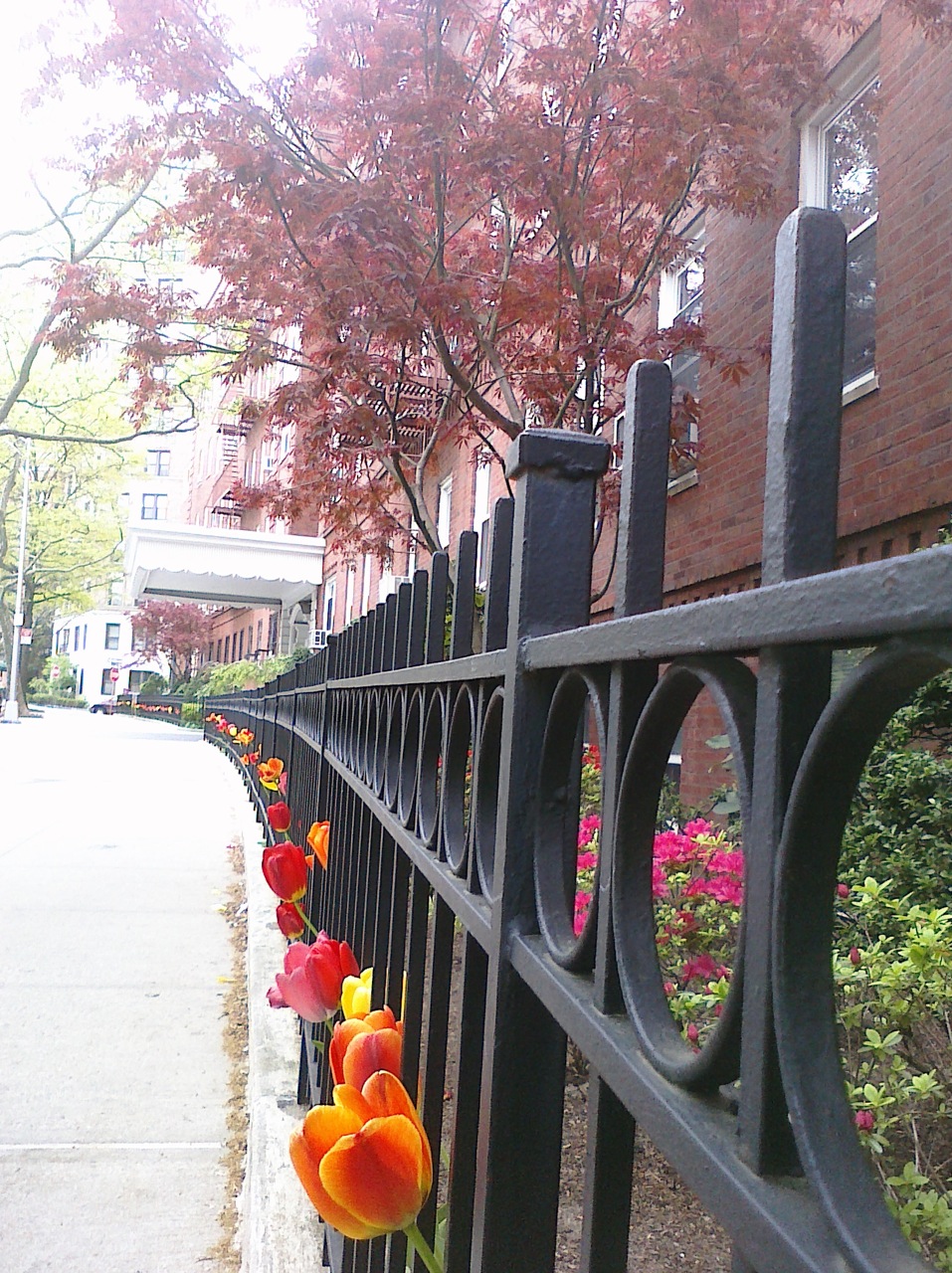
In Brooklyn walking to teach, I pass the rose bushes that inhabit the small garden spaces, overhang the wrought iron fences, and scatter their petals across the sidewalks. I feel waves of joy and gratitude as I observe the blooms, half open, full blown, and wilted, browning petals and the infinite potential of the buds. Just like remembering my own breathing, I nod in recognition of this continuous cycle of creative energy. Without a judgment of what is beautiful or what is not beautiful, or, acknowledging the human tendency to make such judgments, I feel intensely present.

In my upstate world it is earlier than that. It is the crowning moment of the iris bloom. Only the hardiest of shrub roses are open -- it is a rare one of the flamboyant sisters in Brooklyn that could survive the winters here. Yet the irises have outdone themselves as they must with variations and each as wonderful as the next, they stand folded and unfolding their treasures. Tall, short, single, multiple, every hue, fragrant or not, shade or sun, there they are. In the sun the petals are sometimes like the wavering wings of insects, translucent and veined. In the shade they are sparkling glowing and luminescent. A sudden pouring rain and they are drenched, sodden, leaning, and in some cases broken. In every aspect theirs is a direct expression of energy. Each moment is a marvel. When there were only three open blooms, they were an amazement. Now there are hundreds and they are still an amazement. Slug eaten, wind torn, or delicately perfuming the world, this year's bloom will come and go.

When the blooms are done, their leaves will spread open to the sun, their tubers will sink roots more fully into the soil and in time their seasonal death will come. Each moment fully present, just like those Brooklyn roses, rotting on the sidewalk or cascading over the fence. Thank you for sharing the path with me.

Friday, April 2, 2010

Catching & Tossing That Emotional Curve Ball

Yesterday I was hit by the curve ball of my old emotional patterns. My equanimity was gone. I felt as though I was alone in a sailboat doing everything I could just to keep from capsizing. This is a pattern that kicks in when I am judged negatively about behaviors that seem to be part of my nature. So it was a deep exercise in my practice of non-attachment, non-judgment, witness consciousness, self-acceptance, and breath.

I turned to contemplation to help me as I felt myself spiraling down into the abyss. I wrote a poem that it was a hard day to be me. Then went out to weed in the garden. I used my energy to observe, nourish, clarify and act without too much analysis. Then I took a half hour for pranayama practice -- beginning with dirgha 3-part breathing very deliberately sprawled on the floor, arms outstretched, bringing my awareness into my entire body. Breathing in, I was breathing in. Breathing out, I exhaled Om Namo Bhagavate Vasudevaya (May I Surrender to That Which Sustains Me). I felt as though I was pinned to the surface of the earth by its slow rotation as it revolved around the sun. Then I sat up for several rounds of kapalabhati breathing, using all the bandha locks between sequences. Phew. Centered after that, I weeded some more. This was a case of going on ahead and continuing to be active in the world, rather than curl up into that pattern of negativity and erasure. Gently extracting the weeds and placing them in the composting heap to return to the earth transformed. This was engaging and comforting. I, too, will return to the earth transformed. I, too, am just a speck of organic dust or pollen or breath.

Sitting on a stone wall, I closed my eyes, opening my heart to the waves, using "just" on the inhale and "this" on the exhale to pinpoint my attention. All the while, I was feeling the heat of the sun on my left shoulder, the coolness of the breeze from the valley on my face, the solidity of the stone beneath me, the softness of the air drawing in and out of me. All this was there this moment, this moment, this moment.

I began to feel grateful to the person who threw all the cold water on me, smiling as I realized that without being thrown back into that pattern again of questioning my basic being and worthlessness, I would not be gaining this strength in my practice. Finding that I truly can trust that being is all there is for me, that I can see judgment is an external spin that reflects the mind of the one who judges, that everything is conditional until I get beyond the conditional mind, and that I can get there... It was a quiet day. There were meals made and shared, chores done.

This morning I woke up feeling love in the inhale and joy in the exhale. It amazed me that I could so simply and happily be waking up. Then I remembered my feelings from yesterday and the incident that drew them out. I saw all this like a stagnant pool next to where I lay. Oh yes, I could go dip a foot or dunk my whole self in that pool, but I could also just stay on the path and see where the next footfall will land as it lands.

Tuesday, February 2, 2010

A Night at the Opera

Yesterday a friend asked if I would accompany her to the Opera, since her original companion's plans had fallen through and there was an extra ticket. It has been years since I've been to an opera at the Met, and it was to be Carmen by Bizet, an opera in which I actually participated years ago as a child in the chorus. So I said yes, informed my family, shifted out of the plan to have dinner together, scavenged my closet and headed out just as everyone else was coming home.

As disruptive as this was, it was a joyful change in my day. I rarely get out for entertainment of an evening, as a fair amount of my work takes place then, and I've cultivated a pattern of family dinners since I first had children (24 years ago!). As my friend spoke to me on the phone, I felt a moment of hesitation, as my mind scanned how I felt about disappointing other people, adding to their responsibilities and burdens, and missing out on an opportunity for closeness before heading out of town for a few days. Discarding these projections only took a few seconds. I was totally open to the idea of dropping everything and heading out for the unknown in the form of an experience with the Metropolitan Opera.

Shunryu Suzuki, a revered Zen master and teacher who came to the United States in the late 1950's, put beginner's mind at the core of practice. It may seem strange to equate this profound concept with my decision to go to the opera, but my choice came out of the understanding that the mind contains everything. Beginner's mind is an empty mind, an open mind, a mind that holds all the possibilities. He described that "If your mind is empty, it is always ready for anything; it is open to everything. ... If you discriminate too much, you limit yourself. If you are too demanding or too greedy, your mind is not rich and self-sufficient. If we lose our original self-sufficient mind, we will lose all precepts. When your mind becomes demanding, when you long for something, you will end up violating your own precepts: not to tell lies, not to steal, not to kill, not to be immoral, and so forth. If you keep your original mind, the precepts will keep themselves."

My scan of false concepts and my acceptance of a new path took place in a space of non-judgment and non-attachment. I could have been happy or resentful having dinner with my family and catching the news analysis of the day, thrilled or guilty sitting high above the beautiful set designs, peering into the orchestra pit and floating on the vibrations of the human voices filling the hall. Neither of these experiences could actually be predicted. Both offered the full range of possibilities. The open space of an empty mind gave me room to be fully in that moment of choice-making. I was able to eliminate the "should" and "shouldn't" from the equation, and by letting go of my "if-this-then-that mind," the dualistic mind, I was free to make a real choice, to act honestly. My early morning obligations did not cost me any more dearly for having rolled in late the night before, since I was not weighting them down with that mental/emotional baggage. I did not have to charge myself something in exchange for my choices.

When Suzuki-roshi spoke of lies and stealing, at first I thought, "I don't do that." But in the act of choosing the opera, I noticed that flashing impulse to support saying no by making an excuse to my friend. I sensed a desire to feel important in my family structure, as if I was critical to the evening. In this way, I felt myself denying my family members respect for their three-dimensional selves, in essence stealing their freedom to be whole and self-determining and binding them into the falseness of my own projections, just as I was inflating my own sense of self by making myself indispensable. In a matter of seconds, beginner's mind released me from those patterns that limit my own life, and deny others' their possibilities as well.

I have learned this from my yoga on the mat, where there is always this possibility of beginner's mind. The clarity that comes from not assigning value has given me freedom to be more fully myself. I urge my students to eliminate "hard" and "easy," "good" and "bad" from their way of thinking about asana and themselves, and give themselves the space for the inquiry "what is this?" and "who is this?" I rarely second guess my choices anymore, perhaps because I am free now to take responsibility for them. Just as I place my foot in alignment with my knee in an asana, the emptiness of non-attachment/non-judgment supports my mental clarity.

It is no small consequence that I had a great time at the opera, enjoying the late night trains coming home and walking under the waning moon, sneaking into my apartment of sleeping people, and sleeping with a heart full of song.

Sunday, January 31, 2010

Stress? What Stress?

Just this minute I notice my weight is not balanced in my sitting bones. My hunching, my feet slipping forward, my tense shoulders are all part of this imbalance. Taking a moment, I draw my hips back in my seat, establish my ribs and shoulders over them, readjust my feet under my knees, inhale fully and exhale deeply. Then I turn my attention back to the gnarly scheduling dilemma I have been trying to untangle. Already my body feels more relaxed as my weight shifts down into the chair, to the floor and the enormously strong beams and supports below me. They, themselves, rest their weight on the earth below me. It took literally a moment to reduce the effects of stress on my body, and this reduced physical expression actually releases my mind from some of its clenching and spiraling.

The source of stress for me sits firmly in the realm of fear and the unknown. Usually this is a combination of anxiety over not knowing how something will happen or what the results will be, and a mixture of judgmental fears about whether the results will be good or bad; whether I, or a situation, will be successful or effective. Sometimes the fear in uncertainty is a result of my life experiences that cast a certain dye on patterns or behaviors, risks or situations. What happened earlier in my life might have been unpleasant and my anticipation of similar results will stand in the way of my clarity and view of this moment. Disengaging from that becomes part of the process of learning to focus on the present. Readjusting my physical alignment in conjunction with my breath is a terrific, immediate, accessible, free measure I can take any time I remember it!

Potential for stress is a constant of any human life, even that of a yoga teacher. Consider medical conditions, financial situations, family and relational complexities, work environments, struggles of all kinds to provide food, shelter or any level of amenity or certainty. Raising children can raise anxiety levels over the unknown from the most tiny detail (did they find the other glove?) to the larger details (will the school accept their application?) to the global concept (how will our nation's involvement in waging war change our prospects and way of being?). For some, just trying to squeeze a moment for a yoga practice into a busy life can bring more stress! Missing a class leads to disappointment, skipping a day or missing a month might add layers of self judgment and develop hesitations about practice.

The most surprising experience I have had in teaching stress reduction is that my students are fundamentally and profoundly willing to let their stress go the minute they join me in practice. I do not take this personally, rather see that all it takes is my invitation to take a minute on their own behalf, and they are able to do just that. "Inhale looking up slightly," I say, "and exhale letting your chin drift towards your own heart. Breathe there a few cycles, allowing the back of your neck to feel your breath, to release with gravity, and as you are ready, on an inhale draw your head back to a neutral chin position." There ... see ... how willing you were to let go, to give yourself exactly what you need? Just imagine giving yourself this small thing every so often... not that the stress will stop, but you will come to recognize it as something separate from your self, something that you can release any time, any where.

This slight change in perspective can have vast implications. One student asked "how to prepare for reducing stress?" My answer, "just let your attention focus on your breath and you have prepared and reduced stress all in one inhale and exhale!" In fact, take a few breaths, find your foundation (standing, sitting, walking, lying down) and know that as your body undoes the straps of stress that tie you to fears and anxiety, you can live more fully in any moment. Why not this one? When you turn your attention back to the argument, the mistake, the pressure, the impossibility, the unknown, your attention will be clear and your emotions much less stacked against you.

Addressing stress starts with acknowledging that, in all probability, you are almost always operating under some stress conditions. Gradually, learning to release the tensions and stress will help you see your patterns that are creating this stress reaction. Do you really need to feel so possessive of the supplies at work? Must you take that person's suggestions as criticism? Can you offer this suggestion as an opinion without telling that child what to do? Can you use words to explain what felt good or not good rather than shut down and add to the resentments in a relationship? Can you imagine that whatever happens you will have the where-with-all to see the possibilities available? All these little moments add up to a very heavy load to carry around. Give yourself a moment to let it go and see how different you can be. Even though the difficult times might last a while, your awareness and the effects you feel can change.

Thursday, January 28, 2010

DE-STRESSSING: Let Yoga Be a Way Out & a Way In

Last evening I was teaching a de-stress chair yoga for medical professionals and supporting staff members and one participant asked "How many times and how long can I do this to help relieve my anger and frustration?" It was a wonderful question, one rarely asked. It pointed to the deeper questions, of choices and reactivity, of mechanisms developed to support a series of patterns that might not be doing that person any good in daily life contexts. Even the de-stress yoga techniques I was teaching could be fitted into those patterns in a destructive reactive way, used to reinforce formulaic and judgmental responses.

The physical practices of yoga are not really a gym class. The linking of the breath to the movements in the body and the focus that this requires bring awareness to the moment in a way that is not about counting breaths or holding asana or mudra for a specific amounts of time. It might make sense to build strength by gradually adding in a number of chin-ups or time on the rowing machine, but with a yoga asana those challenges often come simply in returning attention to the breath again and again. In this way, doing a relaxation technique or routine of spinal movements may start out as a response to a provocative moment at work or in a relationship, but will open into something quite different than simple endurance or muscle strength (those these are also side benefits of practice!).

Directing attention to the breath and allowing this focus to clarify where there is unnecessary effort is a way of learning to allow the breath to release that effort. Every inhale can bring energy, oxygen, sustaining nourishment. Every exhale can release undue effort, let go of muscle tension, open the mind and body to possibilities. In this way, repeating a simple sequence of hand motions - folding fingers in on the inhale and exhaling, then opening the hand on the inhale and exhaling - acts as a reminder to remember the breath. More than the physical action itself, this is a practice in single-pointed focus, developing new muscles of attention that brings the practitioner into the present moment and releases the person from attachment to the tensions and reactivity that are clutching them. Part of the effect is giving the body time to have its reaction and release it, similar to the technique of counting to ten before reacting in anger; part of the effect is to draw the attention inward to the inherent stability of the breath rather than dispersing energy in reactivity.

Of course the movements of the body open energy channels as well - and provide tremendous benefits in joint health, spinal flexibility, circulation, mobility, organ cleansing, even moderating existing conditions that are the results of habits and emotions, imbalances and chronic behaviors. These net physical benefits also help to reduce stress responses on a physical level, but the key is a fundamental and simple matter. Even in the first experience with yoga a beginner follows the physical directions for body and breath and as the body attempts to follow the directions, the breath begins to support everything that is going on. Whether a student willfully remembers to breathe or not, the body will take the cues and inhale and exhale, extending and releasing, undulating and cleansing, flooding the body with oxygen and supporting effort and relaxation. Letting this sustain you can feel like understanding plate tectonics, gaining trust and understanding of the basic structures that support in being alive.

Of course yoga can be fitted into a judgmental or competitive pattern; an admonition to "practice every day" or to do "this sequence this way" can turn yoga into the same routine as a series of push ups and sit ups, with the same limited effects. And there are times when a yoga practice might become a targeted practice towards a particular challenge or process, like a "goal." Yet the open spaces in the joints are made of breath not will power. And the reduction of anger and stress on the job will not come from adding another reactive response to the sequence. The yoga techniques that help reduce that anger and stress do so because they are more than a reactive response, they quietly transform the reactive moment into a vivid, focused moment of being -- in fact the only moment in which you are actually living... and breathing. You can use them like editing pencils, but their effects will spread like water colors.

Monday, January 25, 2010

Grateful for the Wet Wind

Do you find yourself rushing into your day, rushing in the cold, the rain, rushing through lunch, rushing to meetings, to classes, even to yoga? What is it that pushes you towards that which you cannot yet see, the next place, the next task, your expectations of yourself? It is the mind reacting. Once I hold still for a moment, I can see the uncertainties, fears, hopes and cravings, the anxieties and judgments in my rushing. What is the hurry? Getting somewhere or doing something before what happens? Finishing, leaving, arriving, going, doing all in the frenzy of preventing disasters that my mind presents to me.

In the moment itself, there is nothing amiss. I can walk in the wild wet wind of the day, relishing the way the water clouds my glasses, feeling the strangeness of my own skin and the merging of my watery eyes with the rain itself. The wind has its reasons for its rushing past me, the warm air hurrying to replace the cooler air, the shifting pressures encouraging the movement of energy. It is my will that moves me, the mind in action. I have presented myself with a task, or a commitment, a responsibility or a choice and I am acting upon that in space and time. Being right where I am, I will still get to the train to wait for the next one or catch the one that happens to be pulling right in as I arrive. My rushing will not change the train that is already ahead or behind of its schedule. My mind can entangle me in the urgency of the moment such that I cannot even enjoy running for the station, should I choose to run. Yet even the running can feel exuberant, full of grace and gratitude.

Where are you right now? Rushing pushes us out of this moment. What do you lose? Can you allow yourself to be right there in the wet and wind, on your way to whatever is next but existing in this moment, discovering your own grace? Encourage yourself to be glad of the legs that carry you, your eyes that water, that runny nose, even the cheeks that feel the edge of cold. Experience the moment your feet make contact with the sidewalk, walking or running! Notice how your legs move in your hip joints or how beautifully your body balances, spine rising even as it sits in a wheelchair. Enjoy the way the water droplets find you, and relish your own reactions. This is the path to gratitude and awareness that brings freedom from those very fears, anxieties, pressures, expectations and judgments that push me out of my own life into a whirlwind of suffering.

There are moments when we move faster, moments when we move slower, but the mind can remain open, mindful, and grateful. I can detach from the story of rushing (missing something, losing something, risking something), and bring myself gratefully right into that wild wet wind. I am on my way, and being right here, right now.